Sculptor is back to life’s work after lifesaving stroke care
May 21, 2025
This piece is sponsored by Sanford Health.
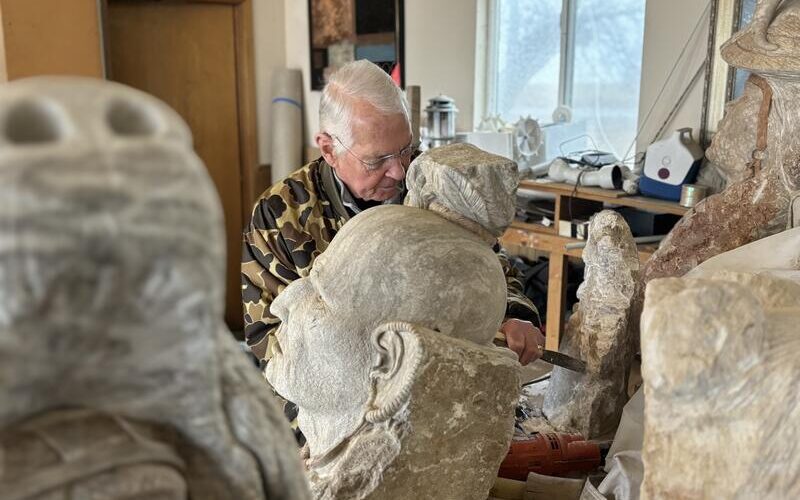
As a self-taught wood and stone sculptor of more than 50 years, Roger Wermers is no stranger to creating miracles.
But he never thought he himself would become a miracle.
‘I could not turn over or get up’
It started out like any other day. Roger and his wife, Joyce, went about their business like any other morning on their farm near Estelline.
“I went down to pick up my clothes and put them in the hamper,” Roger said. “I usually can stand right up, but I realized I was weak. I pulled out the drawer, and I grabbed the door just to work my way up.
“I came out here in the living room, and I lost my balance. I went against the door, and it was unlatched, and the door flew open, and I went sprawling down on the floor.”
His wife heard the crash.
“(His words were) just so garbled, and there was nothing I could do to understand him,” she recalled.

“I could not turn over. I was so weak I could not turn over or get up,” Roger added.
Joyce knew exactly what was happening. Years ago, her mother had a stroke. She knew the warning signs and the importance of a fast response.
She called 911. When the paramedics arrived however, “Roger was up, putting his belt on and ready to go,” Joyce said. He was walking, talking and moving completely fine.
Roger had a transient ischemic attack, or TIA. It’s often referred to as a mini stroke: The blood flow to the brain is temporarily disrupted.
‘That was where the major stroke happened’
Even though Roger seemed fine, the Wermers decided to go to the Prairie Lakes emergency room in nearby Watertown to have Roger checked.
“He was fine by all practical purposes. Perfectly fine. There was a possibility of dismissing him because he was fine. The EKG, the blood work, everything looked fine,” Joyce said.
Then, after everything was seemingly fine, everything changed.
“I fell flat. That was where the major stroke happened,” Roger said.
“I thought we lost him. I mean, this was like death row. It was so, so scary,” Joyce recalled.
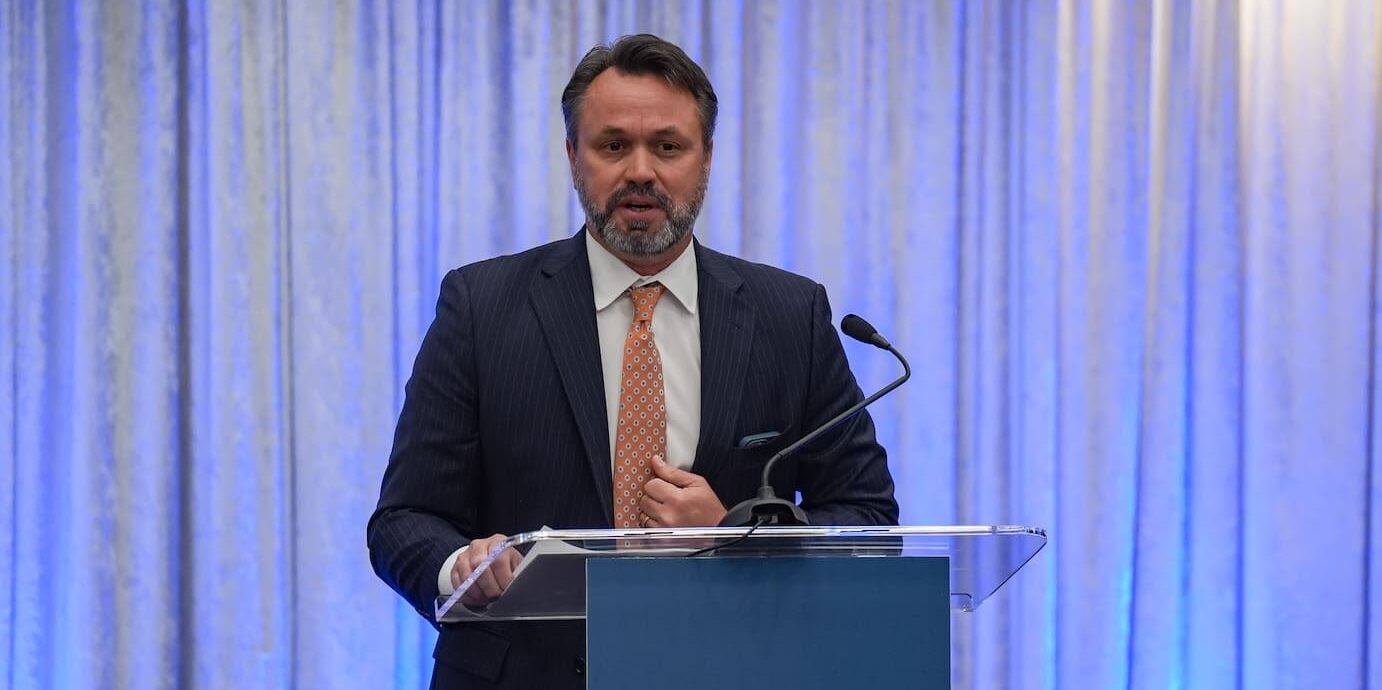
Roger’s care team in Watertown had been in contact with Sioux Falls-based neurologist Dr. Karan Topiwala.
The providers there did a CT scan of Roger’s head to look at his brain and an angiogram to look at the blood vessels, Topiwala said.
“I could see that there was a blockage in his carotid artery, in the neck on the right side, but also in his brain. He was in the process of having a major stroke,” Topiwala said. “His carotid artery was completely blocked.”
‘Time is brain’
Roger was given a strong blood thinner and flown to Sioux Falls.
“As soon as he came to us, I met him in the emergency room and examined him, and he continued to have those symptoms. This unfortunately meant that the clot-busting medicine didn’t completely dissolve the clot, and that happens in 40 to 60 percent of the time,” Topiwala said.
Topiwala met with Joyce to discuss a procedure called an emergent mechanical thrombectomy, “which is basically where I put a catheter in an artery, either in the hand or in the leg, and snake that catheter up to the brain where the blockage is. The catheter physically sucks the clot out of the body,” he explained.

Topiwala first had to navigate through the blockage in Roger’s neck to reach the blockage in his brain.
“It took 36 minutes from the time he was at the satellite hospital 100 miles away from us to when I had put a needle in his leg to get the procedure going. That’s how quickly we can move,” Topiwala said.
After the procedure, the difference was night and day. Roger was able to move his entire left side and get out of bed the very next day.
Topiwala said that when it comes to strokes, “time is brain.”
“Every minute that blood flow to the brain is obstructed, about 1.9 million neurons die; 14 billion, billion with a ‘B,’ synapses – which are connections between those neurons – they are lost,” he said.
“It is important to move as fast as possible knowing that the brain does not have the ability to regenerate. So the neurons or nerve cells are lost forever. I can’t stress how important it is to move fast.”
Streamlining stroke care
And Sanford Health takes pride in moving fast. According to American Heart Association and American Stroke Association guidelines, if someone is having a stroke and comes to an emergency room, blood-thinning medication should be administered in less than 60 minutes.
If a patient is coming in for a procedure, like the emergent mechanical thrombectomy, that should also be done in less than 60 minutes.
“We beat both of those times by 40 percent,” Topiwala said.
Sanford USD Medical Center has been certified as a comprehensive stroke center by DNV Healthcare – the highest level of certification for hospitals that receive and treat the most-complex stroke cases.
“Not just in an acute setting, not just a procedural setting, but also able to care for these patients in a neurological ICU that can deal with specialized neurovascular conditions and has rehabilitation programs where patients can eventually graduate and regain some of those lost functions,” Topiwala said.
There are only about 300 comprehensive stroke centers in the United States.
Topiwala said he and his team are always looking to advance stroke care beyond what’s currently present.
“We participate in national trials, (we’re) enrolling patients like Mr. Wermers in clinical trials that are looking at what needs to be done differently in these devices that are being used to treat strokes. We are also a training site for neurology residents. We have 16 clinical studies we’re enrolled in.”
Back to sculpting
Today, Roger is creating sculptures again by tapping away at them with his handheld tools. His goal is to be back using machines for his sculptures by this summer.

“When I get better, I’ll get my big grinder out, and I’ll go at it,” he said through a hearty laugh.
Earlier this year, his work was part of the Arizona Fine Art Expo.
Joyce said she’s thankful for the care Roger received.
“We got the best of the best,” she said. “I know how critical it is to have the right doctors at the right time, and they couldn’t have laid everything out more plainly (to us). That’s exactly what we needed. Dr. Topiwala made us feel like we were the only patient he had. He truly cares.”