How Dakota State is building a workforce for the technology-driven future
Jan. 6, 2026
This piece is sponsored by Dakota State University.
As technology advances, so often does science, applying said technologies to solve real-world problems.
This inspired the development of a bioinformatics minor at Dakota State University. Bioinformatics is an interdisciplinary field that brought together faculty from DSU’s College of Arts & Sciences and The Beacom College of Computer & Cyber Sciences.
“Bioinformatics applies data science methods such as statistics, machine learning and artificial intelligence to uncover patterns in biological data such as DNA sequences or protein structures,” explained Dr. Mark Spanier, associate professor and department chair of emerging technologies.
Spanier collaborated with Dr. Alex Dececchi, assistant professor of biology, and Dr. Andrew Sathoff, associate professor of biology, director of undergraduate research and department chair of math and science.
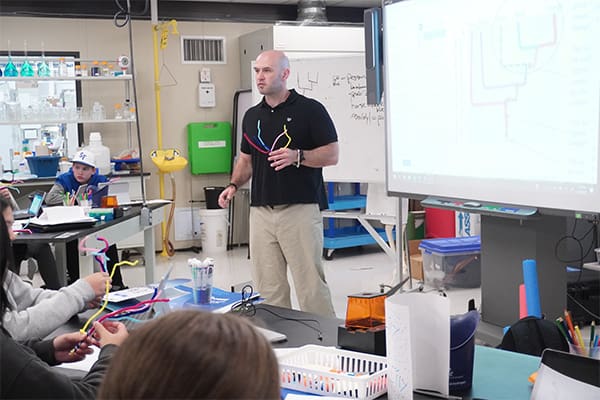
Students enrolled in the minor take biology, math, programming, analytics and artificial intelligence courses to prepare them for future careers as data, medical or environmental scientists.
“Integrating biology and computer science allows researchers to analyze massive datasets, leading to discoveries in genetics, medicine and environmental science,” Spanier said. “Moreover, these challenges drive innovation in computing, spurring new algorithms, techniques and technologies.”
It also gives students broader career options by teaching them transferable skills gained from bioinformatics such as coding, statistics and data analysis.
While the new minor introduces students to how technology drives advances across industries, DSU faculty also have conducted bioinformatics outreach by developing activities for middle and high school students at the Sanford PROMISE Lab over the summer.
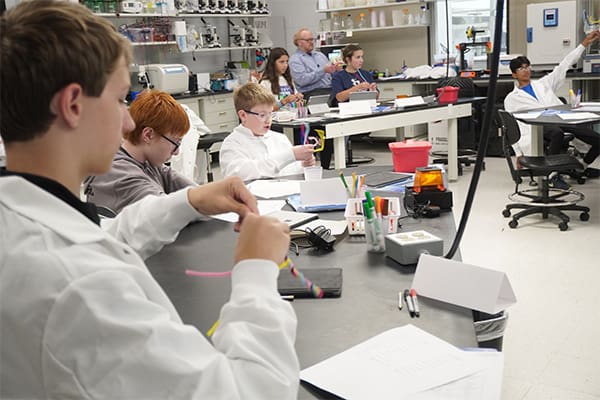
The Sanford PROMISE Lab is the outreach division of Sanford Research that provides STEM events and education to K-12 students. Dececchi and Sathoff were invited to lead a bioinformatics session at the Sanford PROMISE Lab middle school and high school camps.
Ben Benson, a senior research education specialist with Sanford PROMISE, connected with the faculty members at a conference, which led to the invitation to teach a session in the camps.
“Both are passionate about connecting with teachers and students, and they excel at presenting complex topics to younger audiences through hands-on activities,” Benson said.
Amelie Steins, an undergraduate lab assistant and student researcher, assisted in developing age-appropriate activities that taught attendees how to use digital tools and data to answer questions.
The middle school activities focused on phylogenetics, or the scientific study of the evolution of life on Earth. Often described through the example of a tree branching out in different directions, all life on earth is related, and phylogenetics studies the patterns and relationships among different organisms.
To mimic the tree of life, students chose five animals and arranged them in order of evolution using pipe cleaners that served as branches. They also explored a tree of life website.
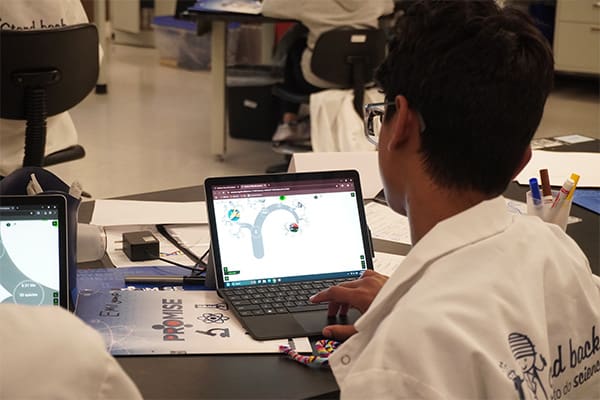
“It was really rewarding to see how curious students are, especially middle schoolers,” Steins said.
High school students in a Sanford PROMISE program called Research in Action learned how to explore publicly available databases and how to connect their new knowledge to diseases studied in the biomedical research facility, Benson shared.
“It provided students with a gateway to see computer science, biology and data analysis not just as academic subjects but as powerful tools for solving problems, exploring their own questions and potentially pursuing future careers in science,” Benson added.
For information about bioinformatics, visit Dakota State’s webpage.