Former Scheels CEO explains why store ‘might not be best fit for everybody’
Jan. 29, 2026
This piece is sponsored by First National Wealth Management.
Whether you shop at Scheels for the clothing, the sports equipment or the Ferris wheel, you can expect an experience driven by the company’s people-first culture and long-standing values.
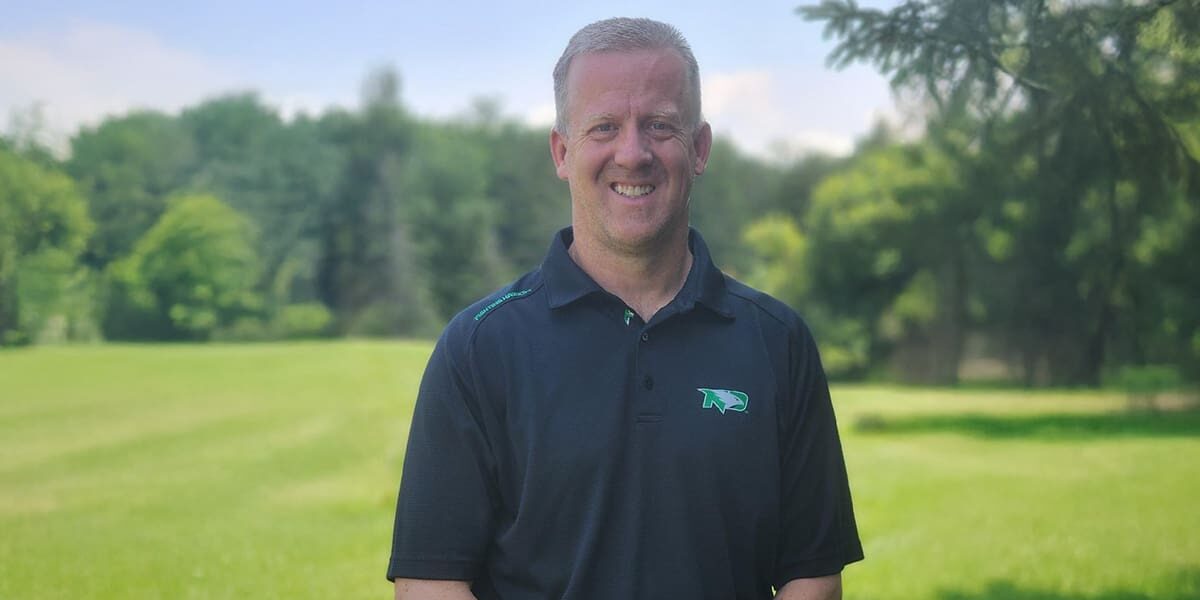
“We might not be the best fit for everybody,” said Steve Scheel, former CEO of the sporting goods store. “We want everybody. We’re going to do everything we can to treat you right, even if you have a different value system. But that’s who we are, and we are not going to change our values.”
Scheel’s great-great-grandfather started the company as a hardware store in Sabin, Minnesota — current population of 619 — in 1902.
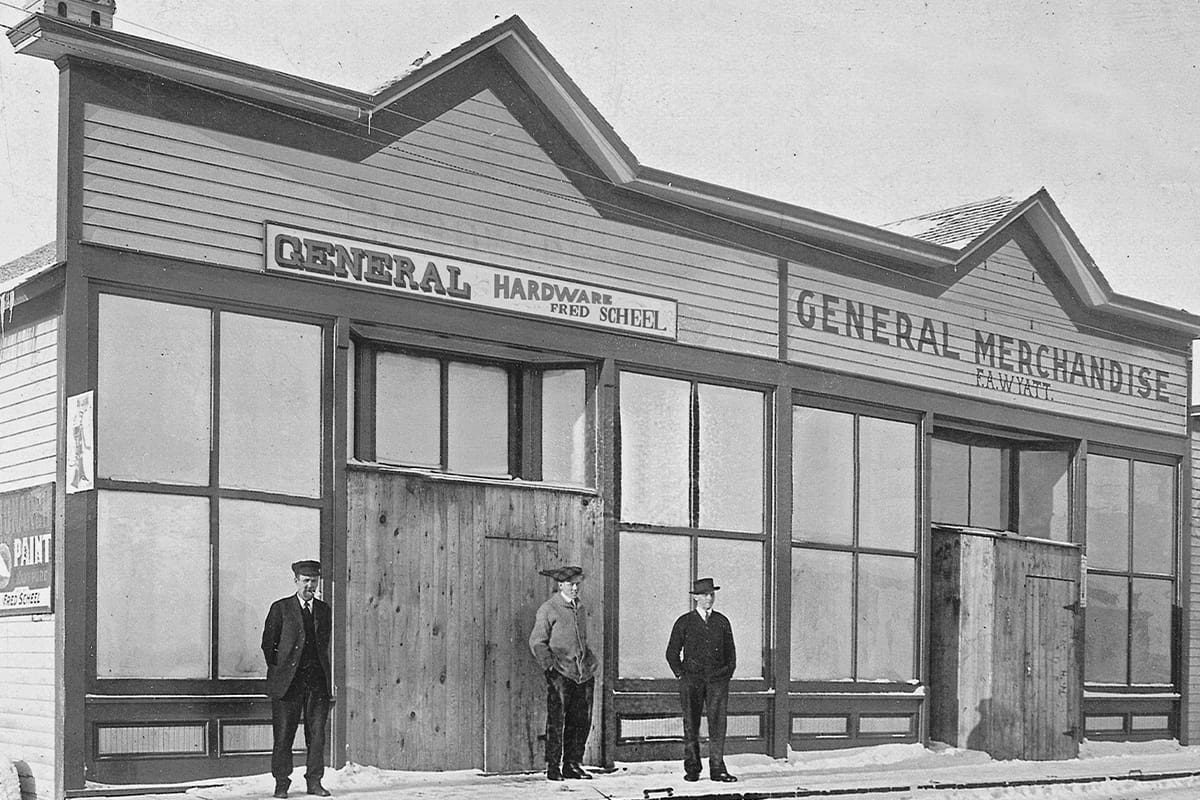
Today, there are 34 locations across 16 states.
“Up until the 1970s, we were essentially a hardware and dry goods business,” Scheel said. “And in 1977, I believe it was, we had our first store that was half sporting goods and half hardware, actually in Sioux Falls, South Dakota.”
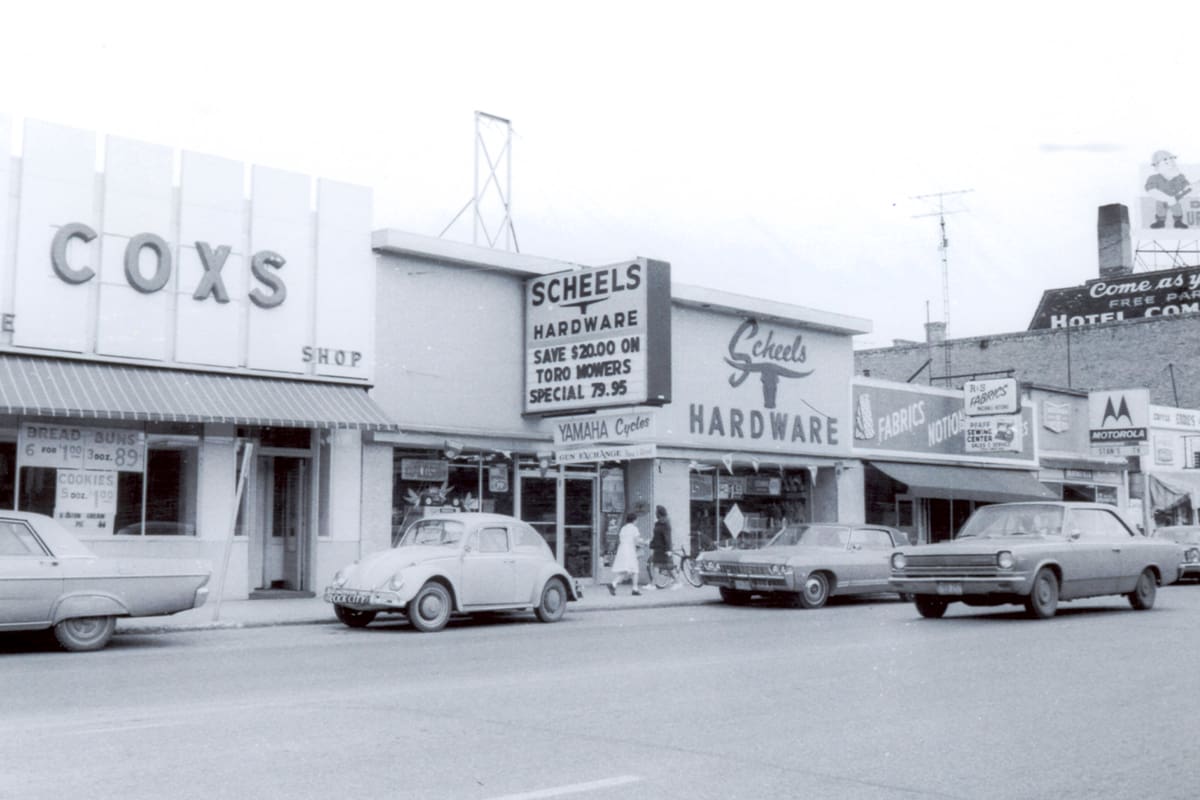
A Scheels Hardware store in 1968
Even with that much history, the past 35 years have been key to the company’s evolution as a premier sporting goods retailer, according to Scheel.
That’s also how long Scheel worked for his family’s business before retiring in 2024.
Scheel recently joined an episode of the Sioux Falls-based podcast “Common Cents on the Prairie” to explain why the sporting goods store isn’t for everyone — and why that’s OK.
The Scheels value system
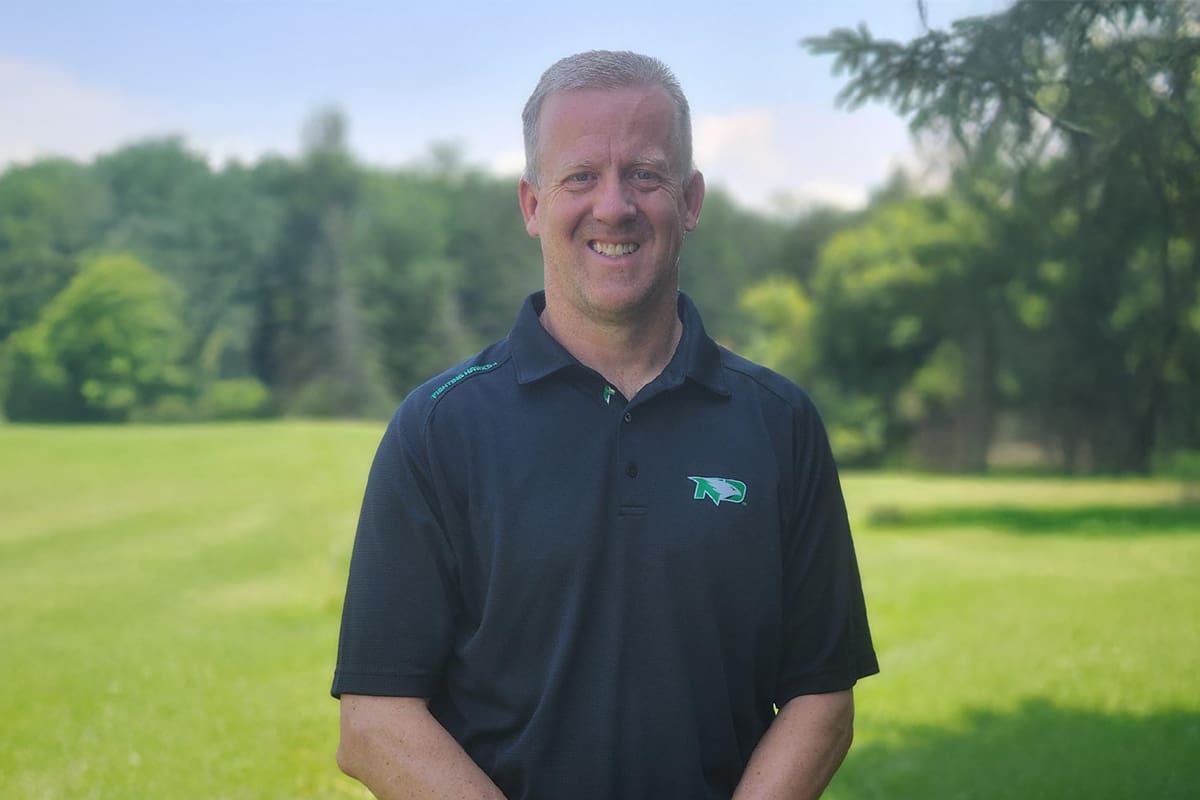
“My grandfather and my grandmother — who I spent a lot of time with growing up, lived very close to — were both very faith-based people,” Scheel said, “and they were very intentional about making that a part of the business.”
They passed down their family values to Scheel’s father, who was a leader in the company all through Scheel’s career and passed the same values down to him.
“Faith is a part of who we are,” Scheel said. “It’s a part of how we treat people. It’s a part of how we want to interact in our communities. And so we are going to incorporate that into our business model.”
He said you might walk in the store and hear Christian music playing “because it’s a family-friendly atmosphere, and it’s the only type of music I know that I don’t have to usually worry about any of the lyrics.”
Furthermore, the company approaches its charitable giving similar to how a church views tithing: give first, not last.
Every January, the stores determine how much money they will give back to their communities throughout the year, “and by Dec. 31, we expect there to be zero left in that pot,” Scheel said.
One more aspect of the faith-based value system at Scheels is how it impacts the company’s approach to leadership.
Referencing the golden rule, Scheel said, “Developing people and treating people the way you want to be treated — or the way you want them to be treated too — that’s definitely part of that faith-based component.”
Inside the Scheels culture
“Anybody can build a big store,” Scheel said. “Anybody can fill it with stuff. You know, that just takes financing. The hard thing to replicate is people and culture.”
When Scheel’s father was CEO, the company shifted its approach from a management mindset to a focus on leadership.
You can see that reflected in the Scheels culture still today.
“We made a conscious decision to stop using the word ‘managers,’ and we did that because we were no longer going to manage stuff,” Scheel said. “We were going to lead and develop people. And that really started with my father when he was CEO; I like to think I picked up that bucket, and I carried it forward.”
During Scheel’s 16 years as president and then CEO, the company especially focused on developing its people and giving employees the opportunity to build a career.
In some cases, they even put the culture ahead of growing the company’s footprint.
“We’ve never worried about being the biggest,” Scheel said. “Quite honestly, we’ve made decisions over the years where we’ve said no to growing faster, just because we wanted to grow the right way and to make sure we had the culture in each one of our stores that does make us different.”
Room for mistakes
When your business has a 124-year history like Scheels does, and when you put people at the heart of your culture, mistakes are going to be made.
“Part of our culture is helping people become great at what they do,” Scheel said, “and if you’re going to do that, you’ve got to give them the freedom to make mistakes.”
As an example, he referenced a shoe that Scheels developed in the early 2000s.
“We ended up donating probably half the container load we brought back over to the United States,” Scheel said. “I feel bad for the people who had to wear that shoe that got donated because it was such a bad shoe.”
He also admitted to making mistakes in leases and negotiations for purchases, adding that mistakes are learning opportunities and that allowing room for growth is an important part of developing leaders.
“Again,” Scheel said, “if your focus is on people, being the biggest by a numerical measurement tends to be contradictory to trying to be a people-first business.”
To hear more from former CEO Steve Scheel, watch the full episode of “Common Cents on the Prairie” below or listen on Apple Podcasts!
If you would like to discuss your own business journey and goals with a financial professional, send a note to the team at First National Wealth Management. They’d be happy to have a conversation.
Any comments, insights or strategies discussed in this article are intended to be general in nature and, therefore, may not be suitable for you and your situation, whatever that may be. Before acting on anything written here, please consult with your attorney, CPA and/or your financial advisor.