USD faculty, students at hub of international chameleon research
Sept. 30, 2024
This paid piece is sponsored by the University of South Dakota.
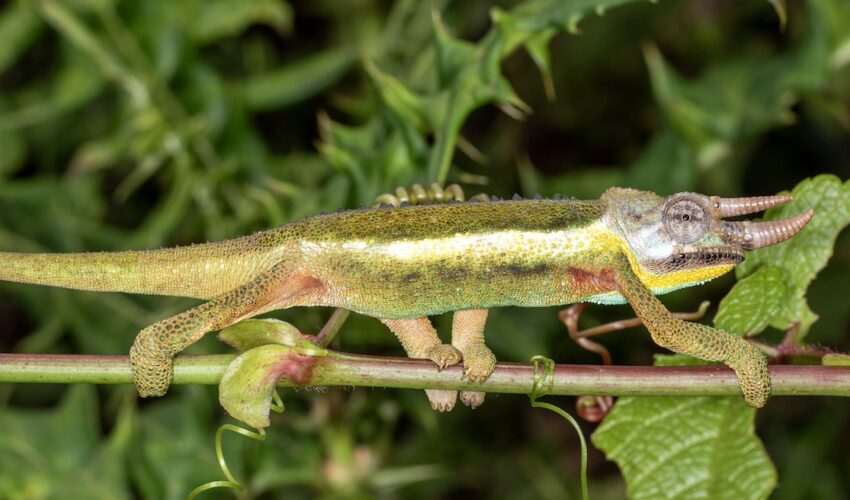
Some of the world’s leading chameleon-related research, conservation and education efforts originate from the University of South Dakota’s department of biology.
Christopher Anderson, associate professor of biology, is at the forefront of these activities.

Since coming to USD in 2016, Anderson has mentored 27 undergraduate students and eight graduate students in his lab, where their research ranges from the effects of temperature on the elastic recoil of a chameleon’s tongue to examining anatomical features of chameleons by creating a vast library of micro-CT scans of what Anderson hopes will be all 228 currently described chameleon species.
Numerous organizations support Anderson’s work. These include the National Science Foundation, which awarded him a five-year, $1.2 million grant in 2022.
His lab’s focus on chameleon physiology and biomechanical systems has important implications.
“Chameleons are highly specialized animals that have numerous adaptations to various aspects of their way of life. This includes explosive performance with their ballistic tongue projection, color-changing mechanisms and independently rotating eyes,” Anderson said. “Studying animals with these more extreme adaptations provides a basis for better understanding ourselves and other animals.”
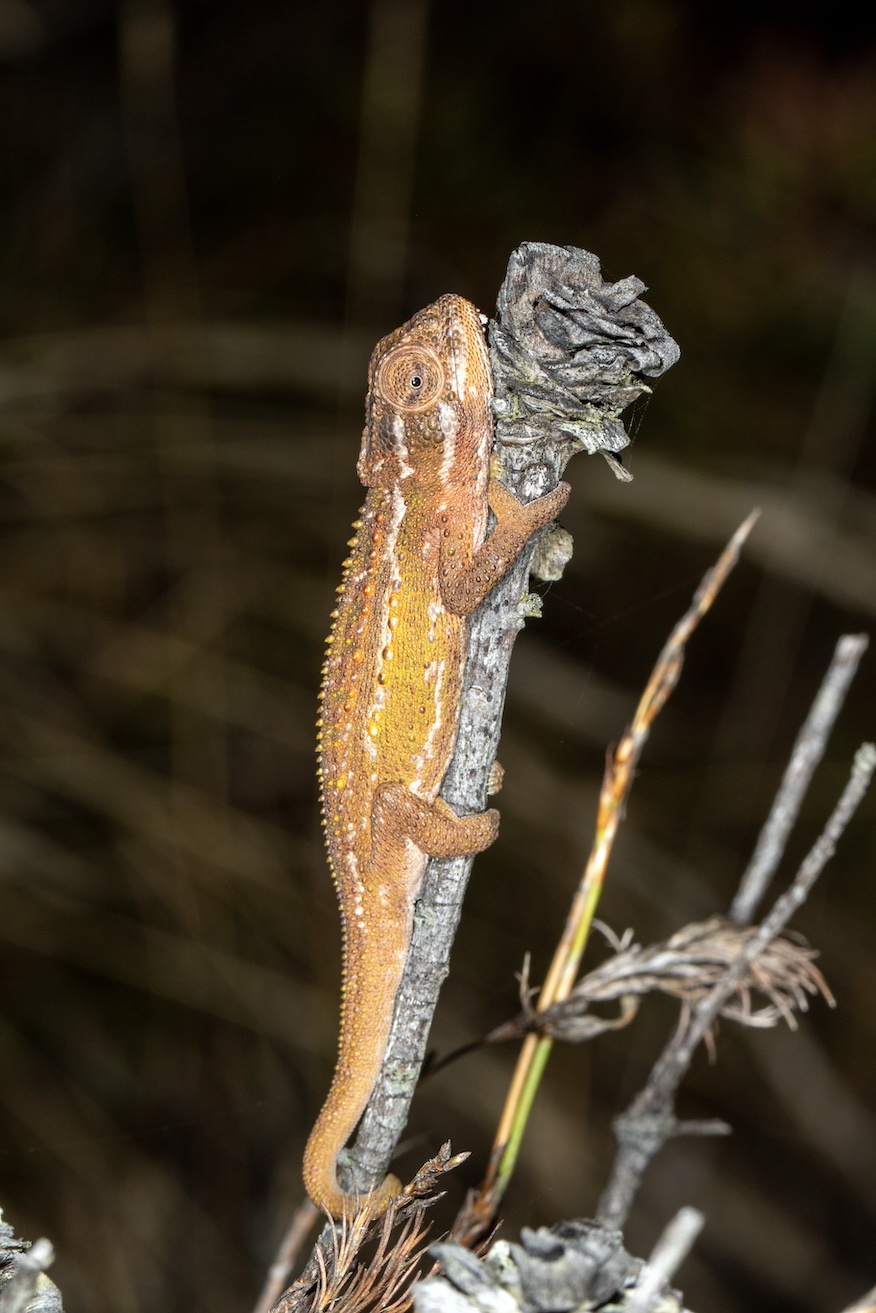
Gaining knowledge of this endangered reptile species also informs conservation work, he added.
“About 21 percent of reptiles worldwide are threatened with extinction,” Anderson explained. “And chameleons are disproportionately threatened – at least 34 percent are threatened with extinction worldwide. Obtaining information about their biology helps us focus on their conservation.”
As part of his chameleon conservation and education work, Anderson is also chair of the Chameleon Specialist Group of the International Union for Conservation of Nature. In that capacity, he coordinates the global conservation efforts for all chameleons and serves as the focal point for any government management authority, nongovernmental organizations or any other entity to contact for chameleon-related data and information.
Interest began in childhood
Anderson’s interest in reptiles and chameleons began at an early age. In middle school, his parents replied to his request for a pet chameleon with a challenge.
“They wanted me to read basically everything I could find on chameleons, and if I was still interested in six months, they would let me get one,” he said.
The budding scientist fulfilled his end of the bargain and got his pet. “It became a little bit of an obsession,” he added.
His background as a hobbyist with pet chameleons complements his academic research, particularly when it comes to the conservation issues he addresses as chair of the IUCN Chameleon Specialist Group.
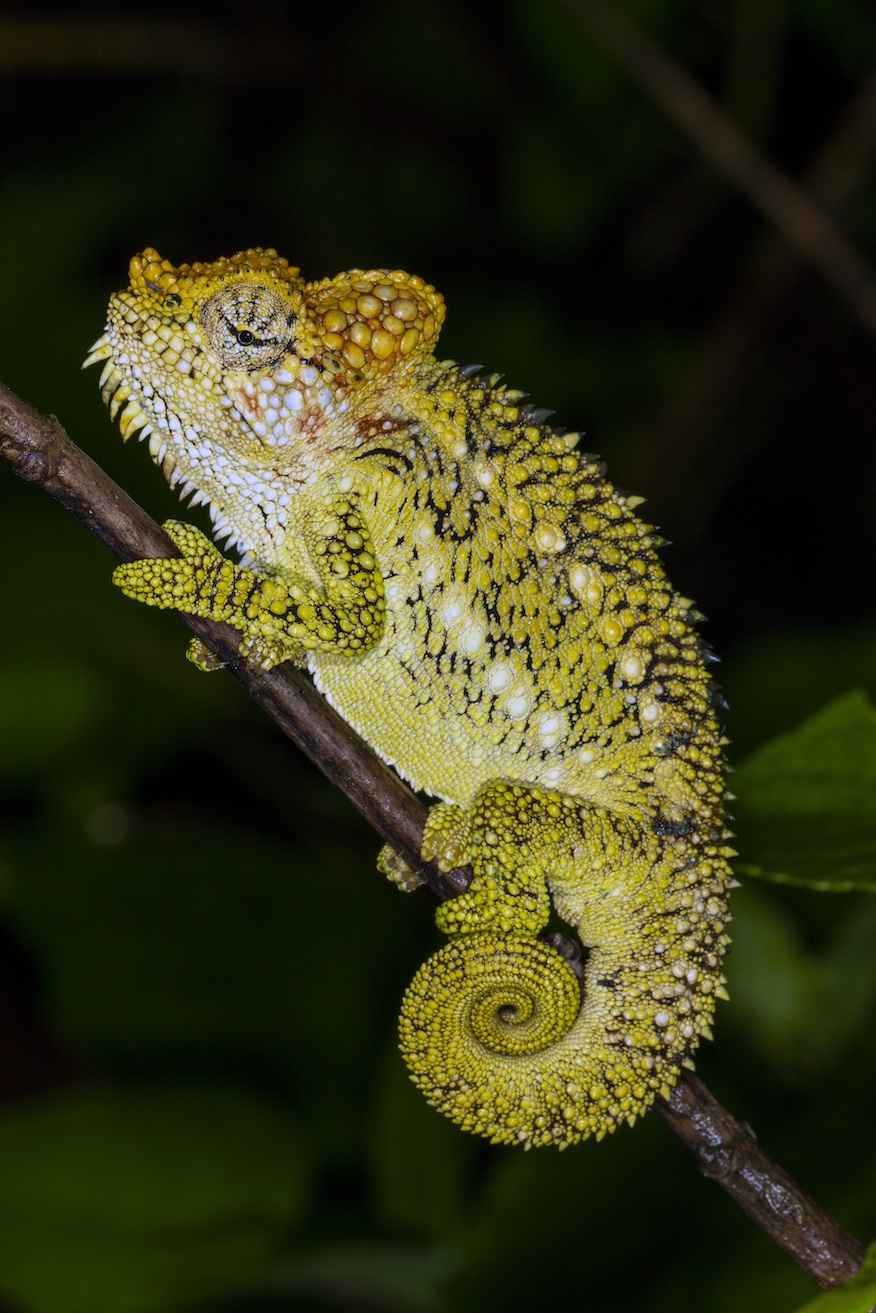
“Chameleons are heavily traded as pets,” Anderson said. “Some of that is quite sustainable, and some is not sustainable at all. We provide data on what the conservation status of chameleons is in the wild so that countries can make informed decisions on sustainable export levels.”
On the research side, Anderson and his students combine field and lab studies to understand the physiology and biomechanics of chameleons in an ecological and evolutionary context. In April, he and Ph.D. students Madison McIntyre and Etti Cooper traveled to South Africa to perform fieldwork for their study of thermal adaptations in chameleons.
One of the undergraduate members of Anderson’s lab was Cydney Even, a medical biology major from Watertown who graduated in May. She worked with microcomputed tomography, or micro-CT, a process that uses multiple X-rays at different angles to create a 3D image of an object.
“My research project involved looking at micro-CT scans of chameleons to identify anatomical differences between those living in arboreal habitats – in trees – versus those living in terrestrial habitats – on the ground,” Even said. “My research aims to explain how environmental pressures can shape anatomical features used in chameleon locomotion. Understanding this not only helps us understand chameleon biology, but it can also contribute to broader evolutionary studies.”
Transferable skills
Even said she joined Anderson’s lab as a sophomore to gain hands-on research experience. Although she had no previous experience or knowledge of chameleons or other reptiles, she jumped at the chance to work with these animals.
“I’m very grateful for choosing this path,” she said. “It’s not only expanded my scientific horizons but also deepened my appreciation for the adaptations of these incredible creatures.”
Even said working in Anderson’s lab equipped her with skills transferable to her future profession in dentistry. These include not only the ability to problem-solve and use advanced imaging software but also an understanding of the relationship between form and function.
“Even though chameleons and teeth are worlds apart, my research has allowed me to draw parallels between chameleon adaptations and the design of dental prosthetics,” Even said. “Understanding how structures adapt to environmental demands offers an innovative perspective on designing dental prosthetics tailored to an individual patient’s needs.”
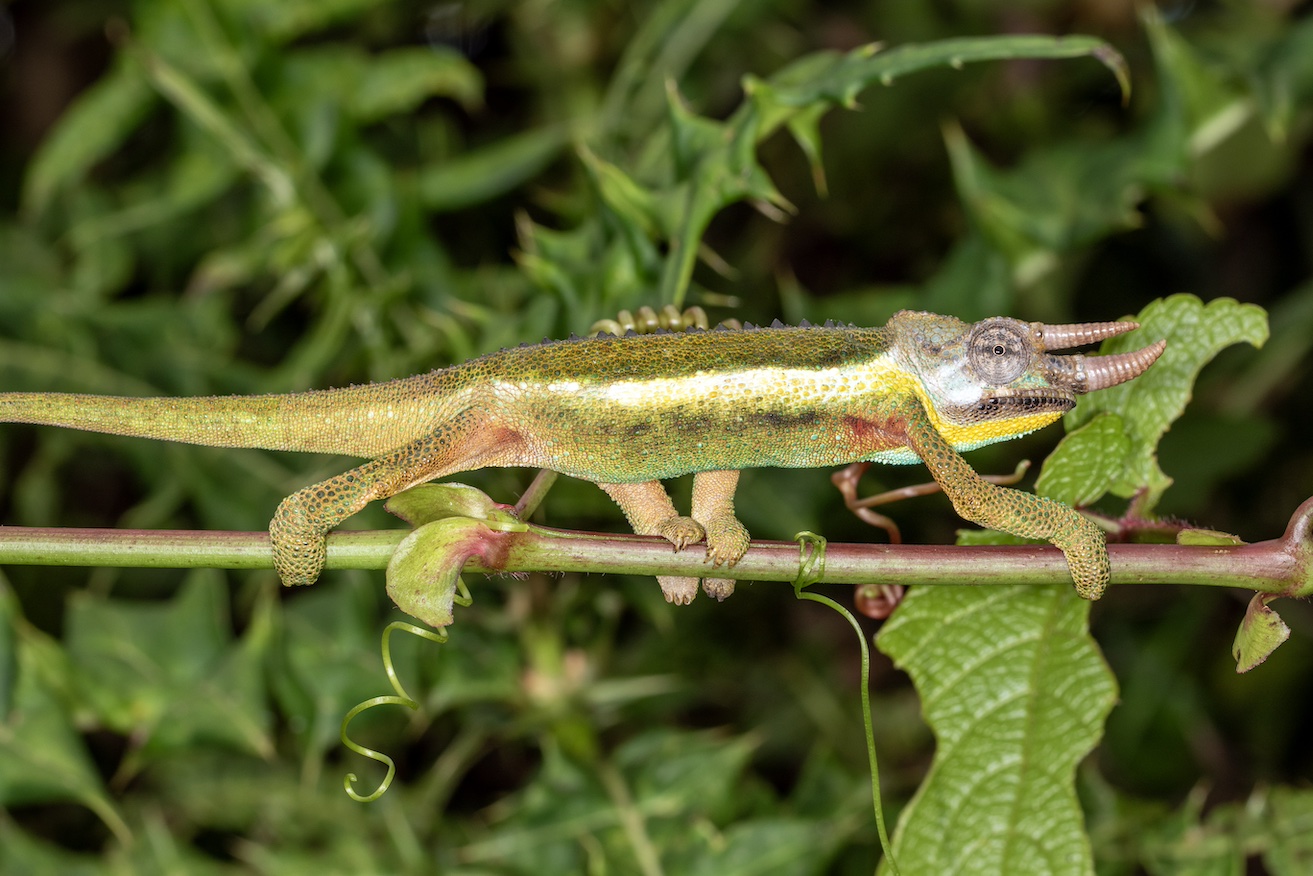
Nikole Schneider, a doctoral student in Anderson’s lab, studies the chameleon tongue and how the animal feeds. The most common way chameleons feed is by projecting their specialized tongues at incredible speeds to catch fast-moving prey. With slow-moving or nonmoving prey such as snails, flowers and fruit, these reptiles will simply capture them with their jaws.
“Chameleons have a specialized tongue and are really good at projecting it out to catch prey; however, what is cool is that it seems they are not limited by only feeding through projection,” Schneider said. “With my research, I want to know whether chameleons are still limited to one behavior, and if this alternate feeding behavior is really just tongue projection on a very small scale or if chameleons are actually performing a totally separate behavior.”
Her results could show whether specialized structures in animals are capable of more broad behaviors than previously thought.
Before coming to USD to pursue her Ph.D., Schneider worked in a lab studying fish and reptile biomechanics as an undergraduate. Now, she can’t imagine studying any other group of animals.
“Dr. Anderson is the reason I came to USD,” she said. “Not only is he a great teacher and mentor, but he is very intelligent and knows everything there is to know about chameleons. He has done research on chameleon biomechanics, morphology, physiology, ecology, phylogeny — any -ology that involves chameleons. If you are interested in chameleons or how they work, the Anderson Lab is the place for you.”