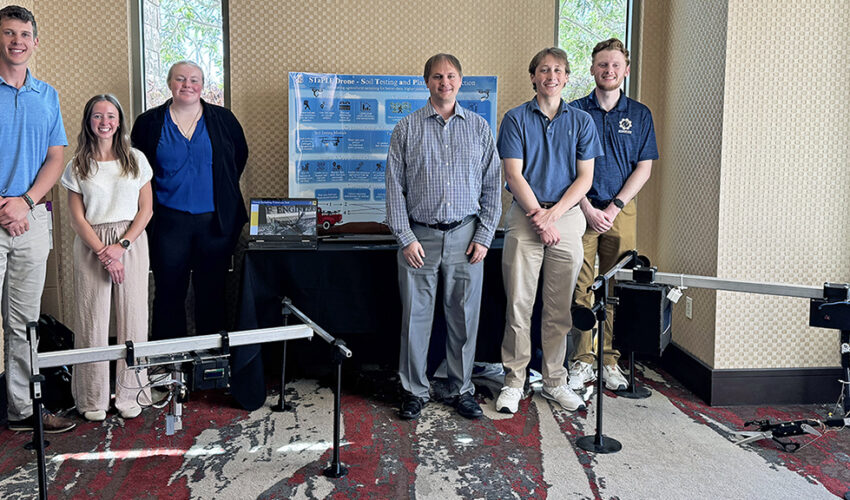
SDSU team takes home big win in NASA competition
May 22, 2025
Four mechanical engineering students from South Dakota State University found a way to make drones more useful for farmers and won a prestigious NASA contest in the process.
The first-place SDSU team was one of eight finalists in NASA’s Gateways to Blue Skies contest, which this year had a theme of AgAir: Aviation Solutions for Agriculture. Teams were instructed to conceptualize novel aviation systems that can be applied to agriculture by 2035 or sooner with the goal of improving production, efficiency, environmental impact and extreme weather/climate resilience.
The SDSU seniors did just that with their STaPLE drone, which stands for Soil Testing and Plant Leaf Extraction.
The product name tells its mission. Using GPS technology and artificial intelligence image analysis software, the drone would fly to determined areas within a field to either take a soil sample or clip off plant leaves for future analysis. The soil sampling module would be used in spring or fall when plants weren’t growing. The extraction module would be used during the growing seasons.
The students estimated a cost of $5,000 to $10,000 per module with payback in less than one year.
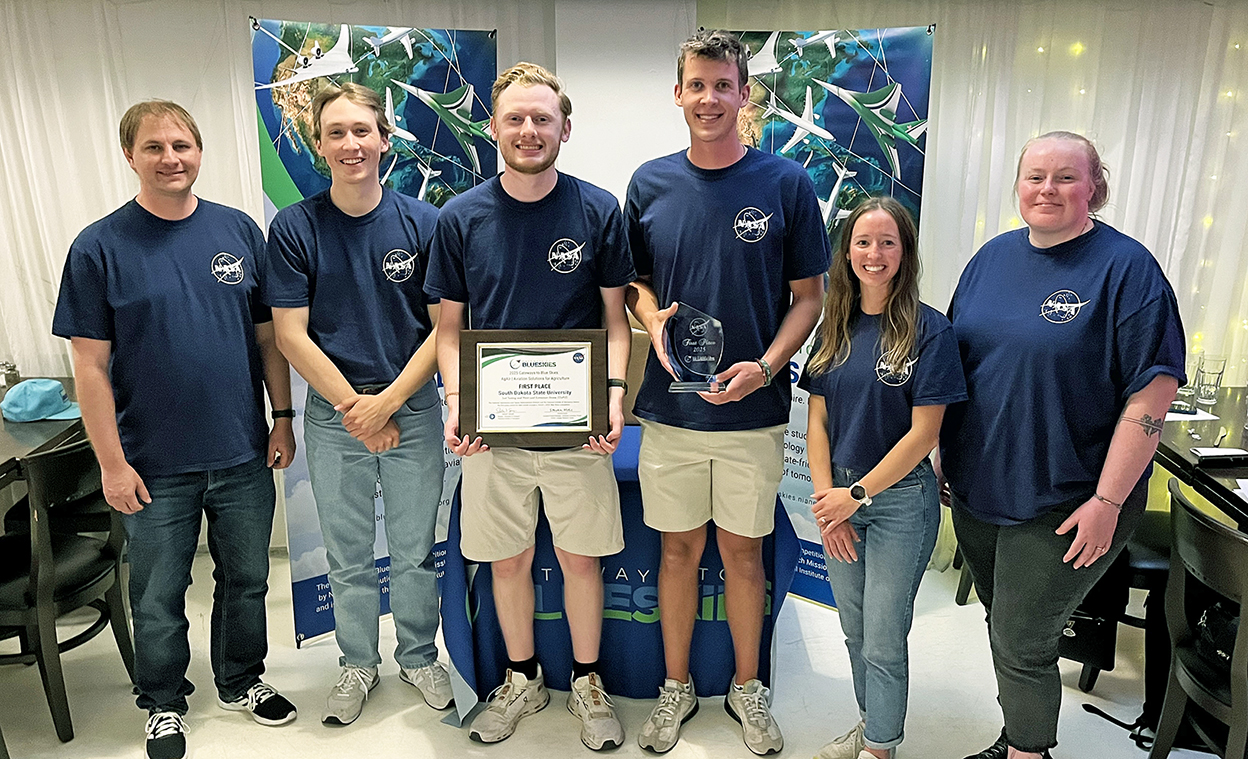
SDSU’s winning team members in NASA’s Gateways to Blue Skies competition hold their awards after the presentation Wednesday at Armstrong Flight Center in Palmdale, California: faculty adviser Todd Letcher, Nick Wolles, Keegan Visher, Nathan Kuehl, Laura Peterson and graduate adviser Allea Klauenberg.
Last presentation, first-place finisher
Their presentation impressed NASA and aviation industry judges this week when SDSU was the final team to make its 45-minute presentation at NASA’s Armstrong Flight Research Center in Palmdale, California.
Going before them were well-known engineering schools such as Embry-Riddle Aeronautical University; University of California, Davis; and Auburn University.
This is the fourth year for the contest, but it is the first year that SDSU has entered.
“This is the other half of NASA. Everyone thinks of NASA as space flight, but NASA also looks at the everything that flies and looks down back at the earth,” Todd Letcher, project adviser and an associate professor in mechanical engineering, said in a statement.
He said he likes this contest because the themes change widely each year, and an ag theme was well suited for SDSU.
The SDSU team included Nathan Kuehl of Avoca, Minnesota; Laura Peterson of Fredericksburg, Virginia; Keegan Visher of Excelsior, Minnesota; and Nick Wolles of Dell Rapids.
Customer research impresses judges
Kuehl and Wolles both come from farm families. But to develop a project idea, the team expanded their outreach, and that impressed the judges.
“Our team leveraged their experience in another one of our programs (the National Science Foundation’s I-Corps in the Great Plains Hub) to learn about their customer base and to design a product that the customers want, not what we think they want,” Letcher said.
“The judges loved that they did I-Corps and talked with 25 potential customers (in the fall) and made sure to call it out at the awards ceremony as one of the reasons they chose us as winners.”
He said judges also were impressed that SDSU’s project “was very practical and something that could be implemented very soon with existing technology and agronomy knowledge.”
To the victor goes …
Being the winner brings a plaque, a lot of prestige, $8,000 to cover travel costs to the finals and the option for NASA internships for the students.
SDSU has had recent success in other NASA contests, but this is the first time that SDSU has been the overall winner at a NASA contest.
Steven Holz, assistant project manager for University Innovation with NASA’s Aeronautics Research Mission Directorate and Blue Skies judge and co-chair, announced the results at a Wednesday night dinner.
“It was very exciting. I think the team was so shocked they just blanked out. It was pretty darn cool for me,” Letcher said.
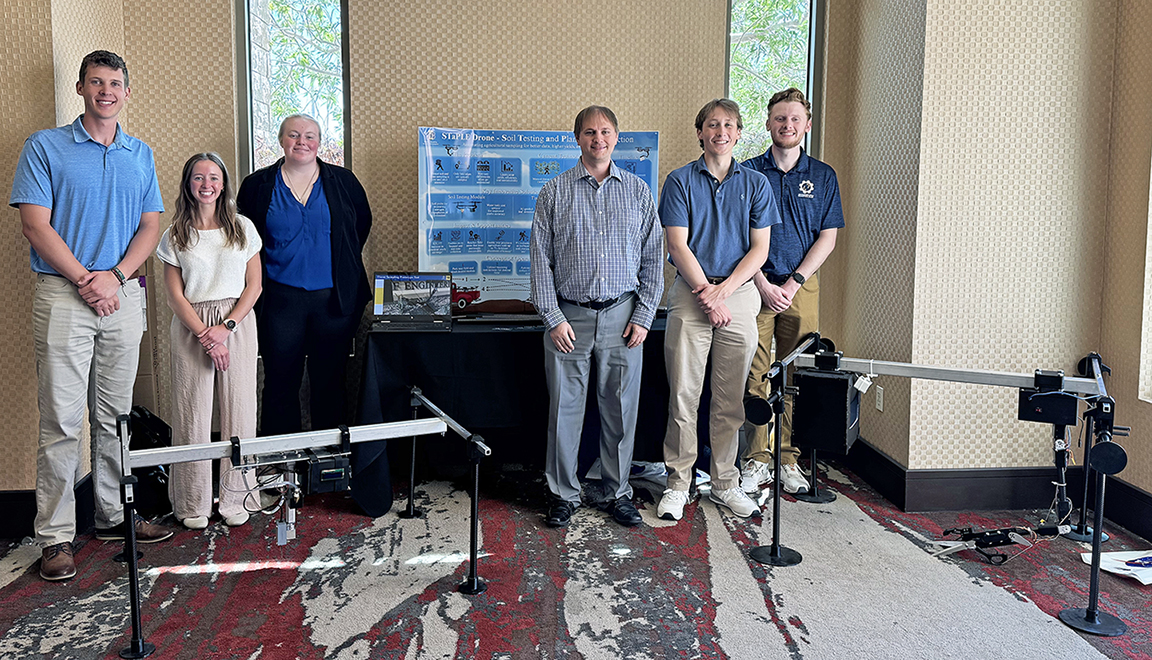
Members of SDSU’s entry in NASA’s Gateways to Blue Skies competition pose with the prototypes of the ag drone modules they built. The soil sampler, left, and the leaf extraction module are designed to fit on a 23-pound drone. Pictured are Nathan Kuehl, Laura Peterson, graduate assistant Allea Klauenberg, facuty adviser Todd Lecher, Nick Wolles and Keegan Visher.
SDSU was the first university in the nation to have a precision agriculture major and provides ample resources for the students’ work, and SDSU’s Jerome J. Lohr College of Engineering has been working with drones for some time, Letcher added.
Startup company AeroFly is the product of a previous NASA contest for college students, and the modules that the students prototyped are slated to fly on an AeroFly drone.
“We received our first drone funding from NASA in 2020. That funding led to our startup company AeroFly, which has secured NASA Small Business Innovation Research Phase 1 funding (2024), and just last week, we found out we received Phase 2 funding for the next two years. Now, we can add winning the Blue Skies competition this week,” Letcher said.
“It’s a great example of how the federal government supports basic research at the university level and that turns into products that can be used in the field in a relatively short amount of time.”
Could be available as soon as 2027
In the students’ presentation, they projected having the soil sampling module commercially available in 2027 and the plant tissue sampling commercially available in 2029. For the current year, they proposed to continue with prototype development, including AI-vision training so the module can recognize what leaves it is supposed to target.
Whether that actually happens is to be determined. All four students received diplomas May 10 and are heading to jobs in industry.
“Until yesterday, I don’t know if the team truly believed they had something this complete and ready for the next step,” Letcher said. “I will encourage them to continue working on this on nights and weekends. I plan to run it through the invention disclosure process through SDSU to see if there is interest in patenting either module.”
Kuehl, who is headed to a job as a control systems specialist with Climate Systems in Sioux Falls, said: “The whole competition was super-rewarding. It was very cool to see how far we’ve come. We’re so thankful for NASA Blue Skies to fly us out here and that we could compete with all these other major schools.”
The next NASA opportunity for the SDSU mechanical engineering department will be the RASC-AL, or Revolutionary Aerospace Systems Concepts – Academic Linkage, contest June 2-4 in Cocoa Beach, Florida, where SDSU has two finalists in the small lunar servicing and maintenance robot division.