Dr. Nathan Skelley creates award-winning surgical video
Sept. 4, 2024
This paid piece is sponsored by the University of South Dakota.
University of South Dakota Sanford School of Medicine associate professor Dr. Nathan Skelley, his colleagues and a USD medical student have been recognized with a prestigious award from the American Academy of Orthopaedic Surgeons, the world’s largest representative body of orthopaedic surgeons.
Skelley and co-authors Hunter O’Connor, a recent Sanford School of Medicine graduate; Brandon Whipple, director of the Sanford Health Surgical Resource Center; and Kyle Cochran, PA-C at Sanford Health; won the 2024 top award in the AAOS Orthopaedic Video Theatre competition for their 25-minute video showcasing a hip arthroscopy surgical technique that they developed at the Sanford USD Medical Center.
Six months after they started making the video, the team submitted the final production, “The Peripheral Compartment First and Periportal Approach to Hip Arthroscopy,” and they were shocked a few months later when they learned that it had garnered the top award with the academy.
The AAOS winning videos were selected by a committee based on educational merit, hi production values and technical quality, as well as the essential matters of clinical relevance and clinical impact.
As an award winner, Skelley’s video was featured on a jumbo screen playing on loop throughout the weeklong AAOS meeting in February in San Francisco. About 30,000 people from around the globe attended the annual meeting.
“My hope in applying to this competition was just to have our video selected for the AAOS meeting and library,” Skelley said. “I never dreamed we would win the top honor!”
“I’m extremely grateful to be involved in a project like this with the potential to have such a big impact on the field of orthopedics,” O’Connor agreed. “I’m proud to represent the Sanford School of Medicine at the national level with this award and show that we are making significant academic contributions to medical care and orthopedics.”
The video was set up, recorded, edited and voiced over entirely by Skelley and his team with the tools they had, an unusual process for other video entrants, who utilized professionals to produce their videos.

Dr. Nathan Skelley receives the AAOS top award in San Francisco. From left to right: Dr. Spencer Matthew Stein, Dr. Joseph Young Choi, PA-C Kyle Cochran, Skelley and Dr. Shariff Bishai, chair of the selection committee.
“Many of the other entrants have professional videography teams that produce, storyboard, edit, voiceover and create these educational videos,” Skelley explained. “This is particularly special because my team created and edited the entire video – we did everything on our own.”
Institutions that have won this award in the past include Yale University, Mayo Clinic, New York University, Duke University and several other top U.S. and international institutions, he said.
“Now, the Sanford USD Medical Center is on that list!”
Operating room video creation began for Skelley in 2022 when he discovered Vumedi, a free global video education platform for physicians based out of Croatia. Skelley pondered how he could contribute his own surgical knowledge to the online learning library. He wanted the highest level of ethics and patient safety with this work and, therefore, obtained patient consent for every video and kept all identifying information confidential – the videos focus only on the patient-approved surgical technique. Original footage is deleted from the camera after production.
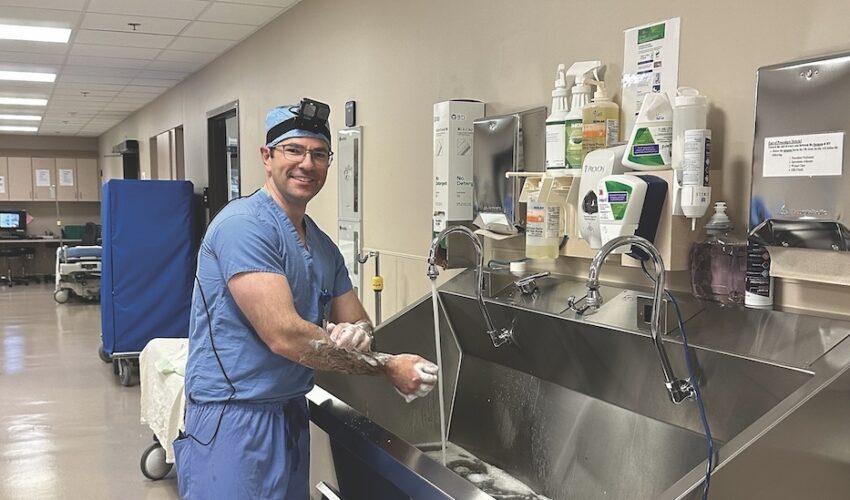
Without access to advanced cameras or video production teams, he decided to wear a standard GoPro camera on his head for the duration of a procedure. After the case, he extracted important clips and recorded voiceover audio during an arduous editing process.
This workflow method allowed him to focus on the patient and not be distracted by the camera angles or lighting during the case. In this manner, he also was able to provide a first-person view to other surgeons, which is unique in medical education videos. This greatly improved collaboration, learning and understanding of the surgical techniques.
Using this method, he and his collaborative team eventually ended up with the award-winning video.
Skelley’s initial goal was to create a few videos to populate the Sanford School of Medicine’s educational video library on Vumedi. With his first video posted to the platform, he hoped to see a few hundred views after the first year. But before long, Skelley saw the number of viewers grow – and keep growing. He also was receiving requests from surgeons across the globe asking for specific videos and topics to help them in their practices. Within the first year, the Sanford-USD School of Medicine video library had received over 100,000 views.
Since then, Skelley has added more than 50 videos across multiple medical education platforms. The team is continuing to increase the inventory of videos on the Sanford-USD School of Medicine’s Vumedi channel as well. The process is time intensive, Skelley said. In many situations, it can take six to eight hours of work to make a five-minute video.

The Sanford-USD Medical School channel has garnered worldwide attention, much more than Skelley could have anticipated. Some of his surgery videos are required viewing at training programs in Germany and New Zealand. Several other videos have been translated into other languages to assist international learners. A South American surgeon completed a surgical procedure for the first time after watching one of Skelley’s videos, and he reached out to thank Skelley for the clarity, comprehensive information and detailed description as it gave him the confidence and understanding to help his patient with a unique problem.
“I have met many great surgeons from around the world through this process,” Skelley said.
“Industry groups have used our videos to better educate their teams. Medical trainees on the other side of the globe are using these videos in their teaching curricula. It is incredibly humbling to realize our work in South Dakota is having this far-reaching and global impact on surgical training. This process has far exceeded my greatest goals and expectations for this initiative.”
According to Vumedi, nearly a half-million clinicians, including one in four U.S. doctors, utilize Vumedi to improve patient care and grow their practice. Currently, the platform has 50,000 peer-to-peer videos in 25 medical specialties, and a majority of the top 20 U.S. hospitals contribute to content.
“Medicine is constantly improving and evolving,” Skelley explained. “We are using advances in technology to improve information transfer and collaboration in an online environment. If I teach a single medical student one concept at one moment in time, they only have that single opportunity to retain the information. If I make a video, I can teach many students at any time, and they have the flexibility to reference the content as needed. The online video library is available to medical professionals, and we can learn from each other and collaborate in this online space to improve our techniques and patient outcomes.

“It is fascinating to me that when I post a video late at night, when I wake up in the morning, I already have questions and comments from surgeons on the other side of the planet. This is a powerful technology and medium. We need to approach this new educational model in a thoughtful and careful manner.”
Medical education is moving to an online platform, and video education has become an extremely popular resource in all areas of medicine, Skelley said.
“Receiving this AAOS award recognition is a phenomenal accomplishment for Sanford Health and the USD Sanford School of Medicine,” he said.
“It is a wonderful recognition of the time, quality, service and work we are putting into these educational videos. We are grateful and honored to represent the USD Sanford School of Medicine in this work and look forward to continuing to lead in this area of medical education. In this manner, we will help to direct a professional and patient-focused educational platform that benefits all patients and surgeons in our care region and globally.”
Physicians can follow Skelley’s Vumedi channel by creating an account and searching for the “Sanford Health – The University of South Dakota School of Medicine: Orthopaedics and Sports Medicine” channel at vumedi.com.