Jodi’s Journal: In data center opposition, don’t miss the bigger movement
Jan. 11, 2026
It takes a certain motivation to show up at a public meeting.
It takes even more to speak publicly about an agenda item.
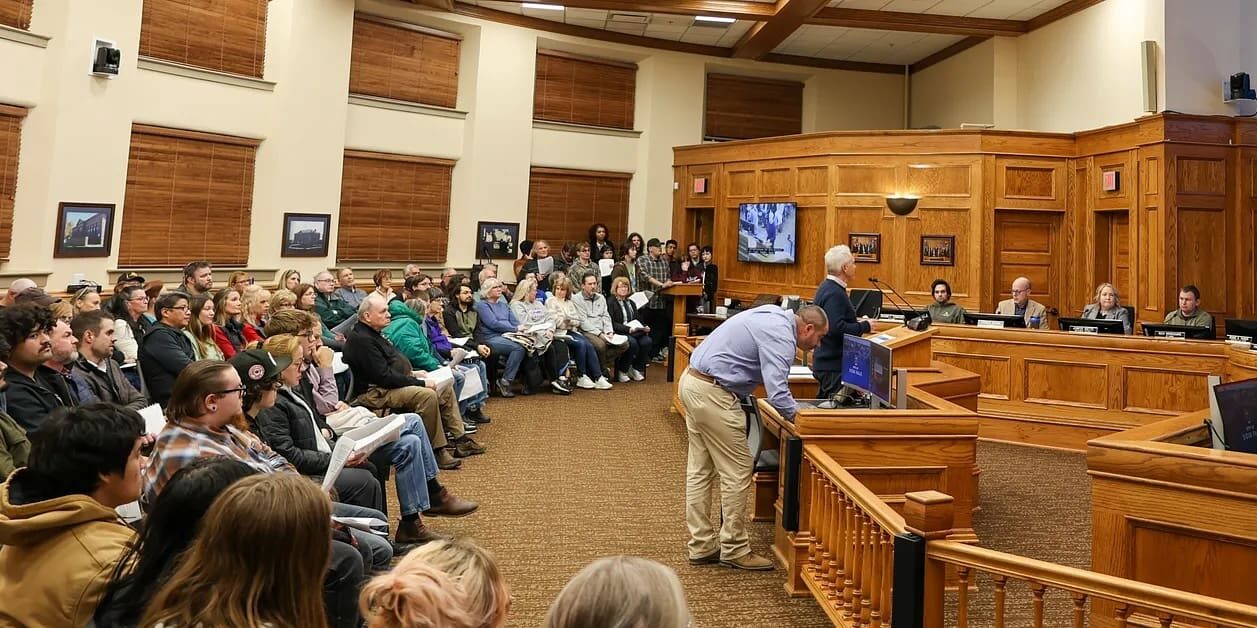
Both were on full display last week at Carnegie Town Hall, where a crowd larger than I can remember in a long time gathered mostly to oppose a proposed rezoning and preliminary subdivision plan.
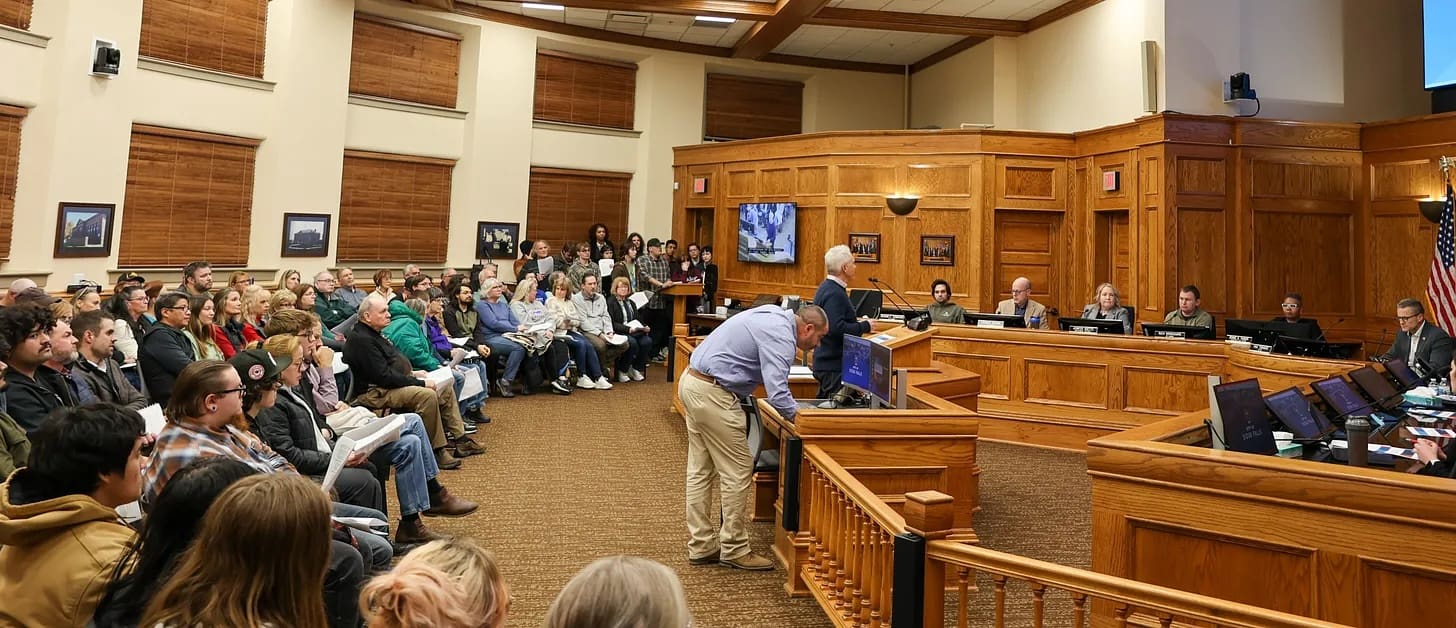
Photo courtesy of The Dakota Scout
You can view the entire meeting here if you’re so inclined, and while it’s more than five hours long, it’s worth hearing some of the testimony for yourself.
Here’s a flavor for how it kicked off.
“We are actually discussing the thermal limit of our future. … We are at a point where neither the natural world or our digital ambitions will survive without immediate radical stewardship,” said Kelsey Hart, a Sioux Falls resident and the first to give testimony.
Hart framed up the decision and what he believes the subsequent climate impact would be as no less than “the difference between a thriving state and a graveyard,” he said. “We are trading the literal lifeblood of our soil for a speculative digital return. If we stay on this path, the Silicon Prairie will become a literal furnace.”
Many in attendance applauded his comments, prompting Mayor Paul TenHaken to cut it off.
“That’s the security guy sitting right there,” he later pointed out. “We have to have decorum in this room tonight. There’s a lot of emotion here.”
It turns out, the scene we witnessed is far from an anomaly.
For an article this month, The Associated Press checked in with Data Center Watch, a project of AI security consultancy 10a Labs, noting that “it is seeing a sharp escalation in community, political and regulatory disruptions to data center development.”
The article noted that “between April and June alone, its latest reporting period, it counted 20 proposals valued at $98 billion in 11 states that were blocked or delayed amid local opposition and state-level pushback. That amounts to two-thirds of the projects it was tracking.
“Some environmental and consumer advocacy groups say they’re fielding calls every day and are working to educate communities on how to protect themselves.”
A member of the Indianapolis-based Citizens Action Coalition, Bryce Gustafson, estimated that he has worked on hundreds of campaigns, “and this by far is the biggest kind of local pushback I’ve ever seen here in Indiana,” he said, noting that he counted more than a dozen projects that lost rezoning petitions.
I didn’t feel like this one in Sioux Falls would be among them. Councilors agreed with the city’s recommendation for light industrial zoning for the 164- acre property about 1 mile south of the Veterans Parkway exit for Interstate 90, near the intersection with Rice Street. It’s owned by Gemini Data Center SD LLC, which is connected to a California-based family office, and just south of Xcel’s Split Rock substation and Angus Anson power station.
Light industrial zoning for data centers appears common but also has been a point of contention in other communities. It can be a blurry line between light and heavy industrial zoning for projects of this nature, prompting some to group data centers as their own stand-alone category, noting their unique requirements and operations.
Still, it’s hard for the average citizen to make a case for overturning layers of justification and precedent surrounding land use — so I wasn’t surprised when the pleas were unsuccessful in this particular vote. I was equally unsurprised when, days later, citizens filed for a petition to collect signatures that could refer the item to a public vote. Generally the high bar for gathering signatures in a short amount of time challenges efforts like this, but I’m not sure I’d bet against this one.
Another key vote also is yet to come: a bill before the South Dakota Legislature on whether to grant sales tax exemptions to qualifying data centers on equipment purchased for their facilities. If this council meeting were any sort of prelude, legislators are about to be deluged with strong opinions.
Concerns about energy use, resulting climate impact, water use and noise were among the issues raised by many who spoke at Tuesday’s meeting. There is information around several of these that I think should quell some of those concerns but enough unknowns that I understand why not all of them feel addressed.
Beyond that, though, was a bigger message I don’t want to ignore — because it goes far beyond any one project or even the concept of a data center. It came largely from some of the youngest people I can remember speaking at one of these meetings — my guess is in their early 20s — and they spoke to what I could tell is a very real fear of how generative artificial intelligence will impact their careers.
“I just see it as very anti-humanity,” Sioux Falls resident Keeghan Paulson said. “This machine that takes what humanity makes and bastardizes it. It spits on it. It makes it something it’s not.”
She does local music photography and sees the tech-driven AI supported by data centers as something that “takes our energy. It takes our children’s energy. It takes our dreams, and it creates a data center that therefore kills it. It kills dreams.”
Shortly after, Sioux Falls resident Caden Mousel agreed.
“Not passing this means everything to me, and I know it does to every kid with future dreams of becoming an artist or a musician,” he said. “You have the right choice. Listen to the people that you represent and choose the choice that keeps dreams alive.”
Of course, it’s hard to see a path forward that stops the evolution of this technology. No halted rezoning or denied incentive in one state is going to accomplish that. The bigger takeaway here is the legitimate fear these and I’m guessing many other professionals have about their futures.
When people quit dreaming about what they could be, it strikes me as a dangerous recipe for social and political unrest at best and total upheaval at worst.
It also calls for a level of leadership I’m not sure exists broadly today — one that can help inspire a clearly needed sense of agency among not just young people but all people. When you lack agency, you feel powerless to influence your own world and the broader world around you. It leads to fear, distrust and anger — all of which were on display last week at Carnegie Town Hall.
If you are a leader, be it of a household, a team, an organization or a community, don’t overlook this need. It’s what will really power the future.