
Winning degree: MBA in sports leadership
April 5, 2022
This paid piece is sponsored by Dakota State University.
It’s easy to think of sports from a spectator perspective, but it’s also increasingly a career field.
And it’s not just coaching. Roles such as fundraising and administration can be found with professional sports organizations or even esports businesses.
To help individuals find success in this field, Dakota State University has created a special education option in its Master of Business Administration degree with an emphasis in sports leadership.
This could be a particularly winning degree for those in the growing esports industry. Esports are wildly popular around the world, and examples are seen on campus as well.
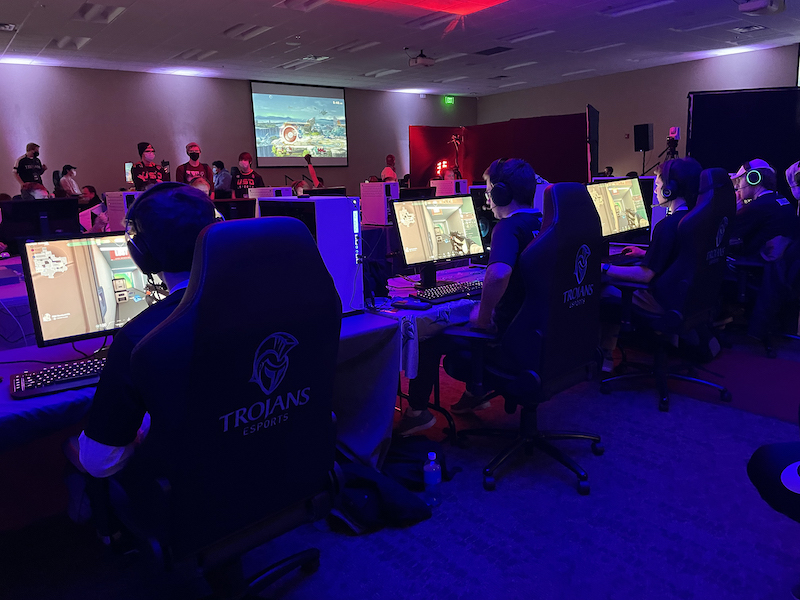
Dakota State added an official athletics esports team in 2019 and now has more than 100 esports athletes. The head coach has created an esports collegiate conference, and an esports arena is included in the plans for the new athletics events center to be built on campus.
“So we have this super-solid MBA program that gives you great education to be a general manager, and for people who are interested in sports management or athletics directors, we have an emphasis that goes along specifically to train people in those areas,” said Dr. Jack Walters, professor and coordinator of the MBA program. The other MBA courses will reinforce that as well, covering leadership, marketing, finance, operations, accounting and business law.
DSU’s MBA, offered since 2010, offers numerous benefits to professionals in many fields by providing a deeper, more intensive education in topics that they need to know, Walters said.

“People with a bachelor’s degree in business receive broad-based education,” he said. “An MBA stands on top of that.”
The MBA program is a rigorous program of study, Walters said, and students can tailor it to their needs, with emphases in information systems, data analytics, health information management or the sports leadership option. All specializations take 10 core courses to build skills that would be expected of someone running a company or part of a larger enterprise.
“One of the key benefits of our MBA is that it improves theoretical and practical knowledge of how businesses operate while also giving the students an education in emphasis areas of their choice,” said Dr. Dorine Bennett, dean of the College of Business and Information Systems.
Because DSU is equipped to be innovative and develop programs to meet the needs of a dynamic and ever-changing business environment, DSU added the sports leadership emphasis in 2019, and this year, the faculty developed new courses to match the needs of students without an academic business background.

Walters explained that many people begin their career in certain subject area, such as chemistry, fine arts or engineering, but as they advance in that field, they often take on more administrative and managerial job duties. These are the individuals who can benefit from the MBA program’s courses.
“When you’re a general manager, it’s shocking the amount of time you spend making business decisions and working with other businesspeople inside and outside the company,” Walters said.
To give nonbusiness-trained people a running start, the College of Business and Information Systems added two foundational discipline courses. These three-credit courses include information on topics covered for a bachelor’s degree in business, with foundational business ideas such as accounting, business law and economics, and more intensive and deeper education in all those topics they need to know.
“This two-course offering prepares a student with or without a prior business education and gives them that ‘general manager’ perspective,” Walters said.
For the specializations, students add two more courses in their particular subject area. The sports leadership specialization, for example, includes two courses offered through the College of Education: Fan Experience, Sportainment & Brand Management, and Facility Risk & Event Management.
Instructors also can give core courses an esports flavor by using classroom examples or cases studies related to sports management.
“No matter where students plan to apply their MBA outcomes, our program contributes to the development of soft skills such as communication, teamwork and leadership to help them be successful,” Bennett said.