‘We’ve always done it this way’ is liability that can lead to enterprise-level risk

Feb. 4, 2026
This piece is sponsored by PRO Resources.
Most small businesses don’t fail because of one catastrophic event. They fail because of a thousand tiny cuts — the accumulated weight of habits that felt efficient in 2015 but are now quietly expensive. And nowhere is this truer than in how companies handle their people operations.
The phrase “we’ve always done it this way” is supposed to signal stability. What it actually signals is risk. The kind that doesn’t announce itself until a regulator shows up, an employee files a claim or your insurance carrier starts asking uncomfortable questions during renewal.
Here’s the thing about operational liability: It compounds. What starts as a practical shortcut — a downloaded template, a handshake agreement, “we’ll figure it out as we go” — becomes institutional. And those institutions have a funny way of becoming legal exposure when someone decides to look closely.
The handbook that time forgot
Let’s talk about employee handbooks. Specifically, the one sitting in your shared drive that someone downloaded in 2012 and has been “good enough” ever since.
That handbook? It has no idea that paid sick leave laws changed. It doesn’t mention remote work policies because nobody worked remotely when it was written. The harassment prevention section still references a training video you haven’t shown anyone in six years. And the discipline procedures are so vague that every manager interprets them differently, which, as it turns out, is a fantastic way to invite a discrimination claim.
An outdated handbook isn’t just embarrassing. It’s evidence. When an attorney is building a case against you, this is the first place they look. They’re not looking for perfection — they’re looking for inconsistency. For gaps between what you say you do and what you actually do. And your 2012 handbook is basically a road map to those gaps.
Most small businesses don’t update these documents because everything feels fine. Right up until it very suddenly doesn’t.
Misclassified roles: The six-figure oops
Let’s say you have an “office manager” who has been salaried and exempt for eight years. Great. Except the Department of Labor just updated its guidelines on who qualifies as exempt, and it turns out your office manager doesn’t meet the new criteria. Congratulations — you now owe back overtime. Possibly for years.
This isn’t theoretical. We see it constantly. The assumptions are always the same: “They’re salaried, so they’re exempt.” “We’ve always classified this role this way.” “The title says ‘manager,’ so we’re fine.”
Regulators do not care about your assumptions. They care about actual job duties, actual documentation and actual compliance with constantly shifting tests. Misclassification doesn’t just mean back wages — it means penalties, tax implications, potential class-action exposure if multiple employees are affected and a truly miserable conversation with your chief financial officer.
And here’s the kicker: If one employee figures this out and gets compensated, you can bet they’re telling everyone else in that role. Dominoes don’t tip in your favor here.
Timekeeping: Where good intentions go to die
Picture this: Your field techs write their hours on paper timesheets. Sometimes those sheets go missing. Sometimes supervisors “approximate” hours if someone forgets to turn in theirs. Different departments have different processes. One manager is strict about documenting breaks; another isn’t. Everyone knows roughly what everyone worked. Close enough, right?
Wrong.
If an employee disputes their hours — and they will, usually right after a termination — the burden of proof is entirely on you. “We think they worked about 40 hours” doesn’t hold up. Your handwritten timesheets with supervisor edits? Also not great. The fact that different departments track time differently? Actively harmful.
Informal timekeeping systems “work” until the moment they spectacularly don’t. Usually during an audit, a financing event or — everyone’s favorite — a lawsuit. The liability here has a long shelf life.
Safety: ‘Everyone just knows’ isn’t a program
Small teams love to say, “Everyone knows how to stay safe around here.” And maybe they do! Until someone gets hurt, and suddenly you’re explaining to OSHA why you don’t have documented training, incident reports or a formal safety program.
“Common sense” doesn’t count as a safety protocol. Informal practices — the kind where training happens via shoulder-taps and safety equipment requests go through a manager’s personal budget — create exposure. Preventable injuries. Unreported incidents. Rising workers’ comp premiums. OSHA citations that make your insurance carrier nervous.
The worst part? Even a minor injury can look like systematic negligence if you can’t produce documentation. No training records. No incident logs. No established protocols. That’s not “we’re a small team” — that’s liability.
PRO provides safety inspections, training and — critically — acts as your operational interface with OSHA and your work comp carrier when incidents happen. Because “we’ll deal with it if something happens” is not a risk management strategy.
Regulators don’t scale their expectations based on company size. Risk is risk whether you have 15 employees or 1,500.
The problem with ‘We’ll know when it’s a problem’
Here’s the irony: The things that make small businesses great — speed, flexibility, trust-based operations — are the same things that allow risk to accumulate invisibly. You don’t feel risky. You feel efficient.
But over time, the gap between how things are done and how things must be done gets wider. Routine processes quietly convert into regulatory exposure. And this gap almost never closes on its own — it takes external pressure like an audit, complaint or attorney’s discovery request to force the issue.
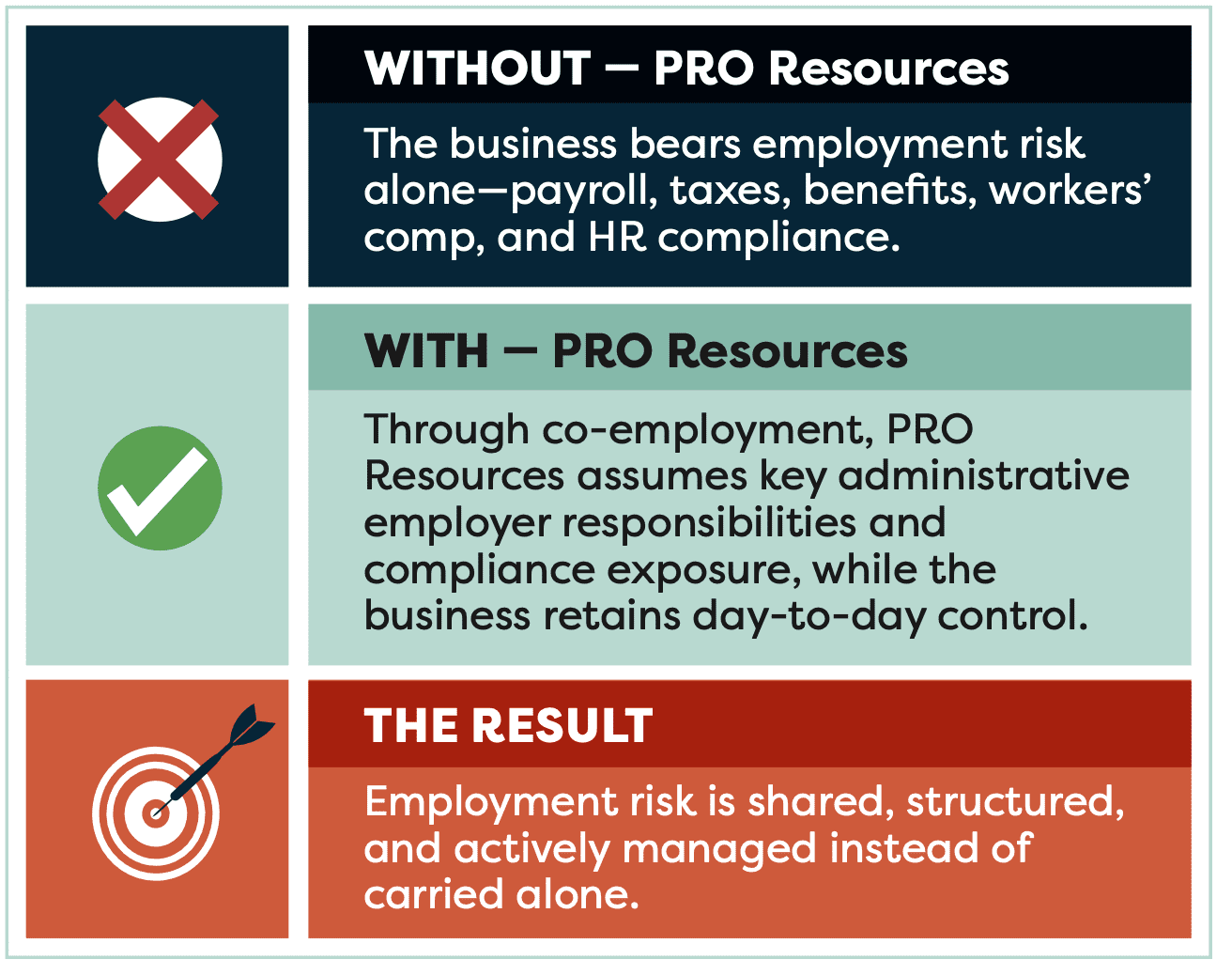
This is why structure matters. This is why co-employment exists. Not because small businesses are doing something wrong, but because the compliance landscape has gotten complicated enough that informal systems create real exposure.
How PRO helps you fix this before anyone comes knocking
At PRO, we specialize in eliminating the silent risks that accumulate when businesses rely on “we’ve always done it this way.” Our job is to identify and close gaps before they become problems. Here’s how:
- We modernize your policies and handbooks. We align documentation with current laws and operational realities. Your 2012 handbook isn’t going to cut it — we make sure your policies reflect today’s requirements.
- We audit and correct role classifications. We review actual job duties, identify misclassification risks and restructure roles to comply with current Labor Department guidelines. Then we build the documentation to defend those decisions.
- We implement real timekeeping systems. No more handwritten sheets. No more “approximations.” We help you adopt validated systems that create unquestionable payroll records.
- We formalize your safety program. Training. Documentation. Incident management. We bring structure to what’s currently informal — and we act as your interface with OSHA and your work comp carrier when things go wrong.
- We proactively identify risks. Our entire business model is finding problems before regulators, attorneys or auditors do. We’re not here to fix disasters — we’re here to prevent them.
Habit is not a strategy
“We’ve always done it this way” might feel comfortable. It’s not a defense. It’s not a shield. It’s just habit — and habit doesn’t hold up under scrutiny.
The businesses that thrive aren’t the ones that wait for external pressure to force updates. They’re the ones that systematize, modernize and de-risk before they have to.
So here’s the question: If a regulator or attorney reviewed your people operations tomorrow, would your systems defend your intent — or expose your habits?
PRO helps small businesses replace tradition-driven operations with compliant infrastructure that protects the company and its people.
Because the best time to fix hidden liability is before someone else uncovers it.
To learn more about how PRO Resources can support your HR needs, contact Jason Boutwell at jboutwell@proresourceshr.com or 701-200-1400.
Keeping your best people: Why retention must be core strategy for small businesses