Jodi’s Journal: The future governor’s people problem
June 7, 2026
Buried underneath a week’s worth of state and local election news, you’ll find an important headline: Sioux Falls and Rapid City now share the nation’s lowest unemployment rate.
Both metro areas clocked in at a 1.7 percent jobless rate in April, according to the most recent data available from the U.S. Bureau of Labor Statistics.
For Sioux Falls, it marked the first time since last November holding the No. 1 spot in the country.
There are plenty of ways to interpret this number. On one hand, it’s encouraging that employment is so robust in our state’s largest communities. On the other, the incredibly low jobless rate can be a deterrent to business activity when employers worry about being able to attract and retain a workforce.
Ideally, a competitive labor market is good for workers — leading to higher wages and more enticing benefits. In reality, it often means when jobs go unfilled, those who do work must work more, while businesses limit expansion and by extension advancement opportunities.
Take a look at the state’s population growth in terms of sheer numbers according to some of the most recent data available that was compiled by the Dakota Institute:
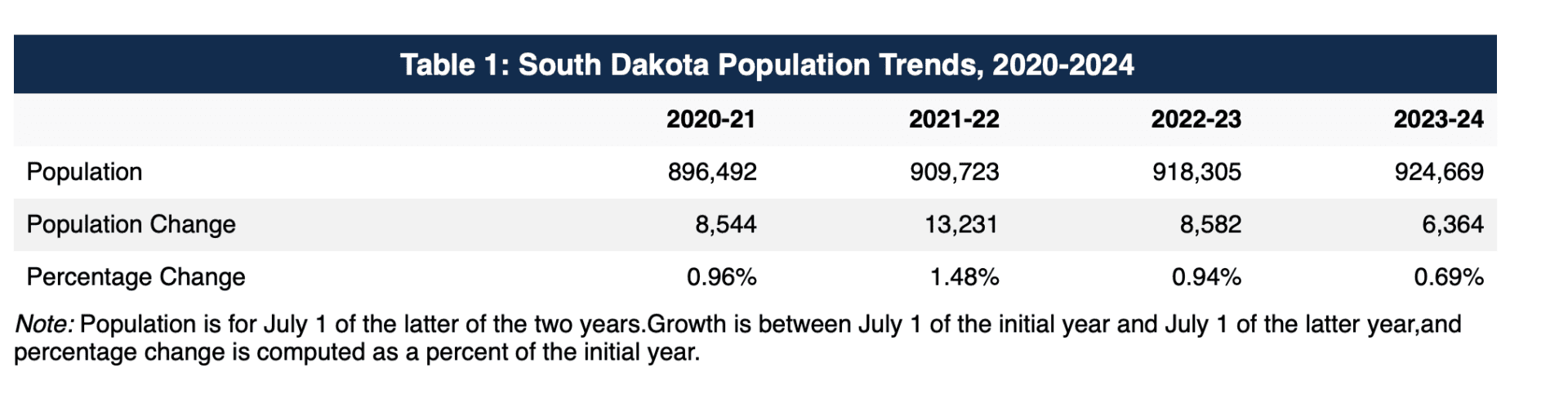
It is striking to see what happened during the pandemic years — a clear increase in population for a state that could benefit from it, followed by a notable drop. Much of the activity centered in the Sioux Falls and Rapid City metro areas. And a big chunk of it has to be credited to former Gov. Kristi Noem.
Regardless of your perspective on Noem’s politics or policy, she elevated the profile of this state to a level that it literally prompted people to pick up and move here. I interviewed many of them. In nearly all cases, it wasn’t that they necessarily relocated here to live in a place governed by Noem, but her sales job for South Dakota prompted them to open their minds to making a move here.
Once they came, they generally didn’t talk to me about the political environment. They talked to me about the same things you probably find appealing about living here: the welcoming community, a feeling of safety, the natural environment, the schools and the opportunities to grow a business, advance one’s education and find affordable entertainment.
But it starts with a leader and a voice that can tell South Dakota’s story. And in this moment in time, it also demands someone able to help write the next chapter of that story.
What is going to compel someone to move to South Dakota in the next eight years, under the leadership of its next governor? What immediate improvements and future groundwork are going to be initiated? What’s the vision for creating a place that speaks to the challenges and opportunities of a 21st century advancing faster than some of us probably imagined and bringing with it unforeseen risks?
State government can be hamstrung from directly investing for growth because we have limited our own ability to generate public revenue as a state. Much of the dialogue I’ve seen in gubernatorial campaigns calls for curtailing that revenue even more. It’s an understandable political message at a time when consumers have endured years of inflation and most recently energy costs that likely will persist indefinitely at this point.
But it’s also shortsighted at best and disingenuous at worst, given no one person can dramatically change taxation in this state, and cutting public services generally doesn’t make a place more appealing.
I have talked to many people who have moved out of South Dakota over the years, and I cannot remember anyone telling me the move was prompted by the cost of living here.
Instead, they moved for more: more career opportunities, more educational options, more quality-of-life amenities.
In the weeks leading up to the runoff election and the general election for governor, I would love to hear how the candidates strategically will lead growth in a way that attracts new residents. What will you do to bring workers to a state that so clearly needs them?
Given the hybridization of today’s workplaces, many people increasingly can choose where they want to live regardless of where their employer is based. It makes competition among states for residents even greater. Think about that in the context of rural communities, and the equation can become even more challenging.
A below-average unemployment rate isn’t a bad thing. It probably helps us hedge against potential job loss from technology. But adding 6,300 people a year to the whole state, as we did in the most recent report, doesn’t leave much room for businesses to grow their workforce. Sioux Falls has benefited from a steady annual population increase. Imagine if the rest of the state could achieve the same.
Our next governor needs a strategy for tackling this “people problem.” It’s hard to call yourself a business-friendly state with a labor market as tight as it sits today.