New development in Tea proposed to include city golf course
June 8, 2026
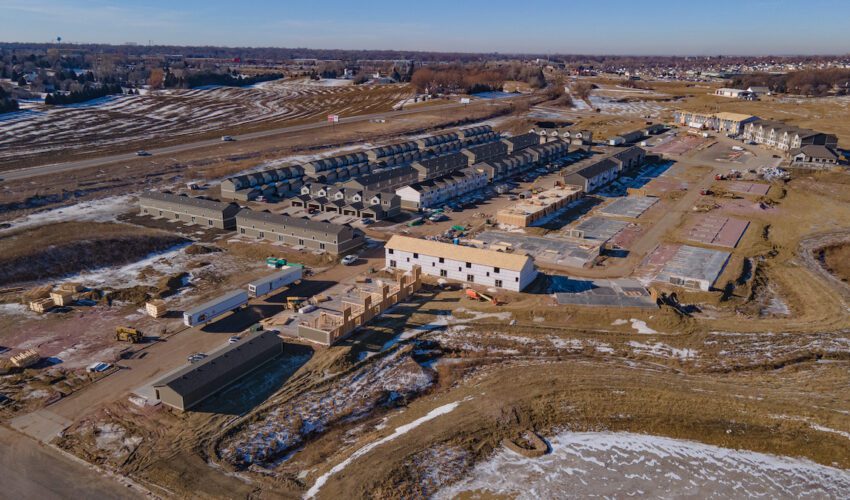
A new housing development in Tea is envisioned to center around a future city golf course.
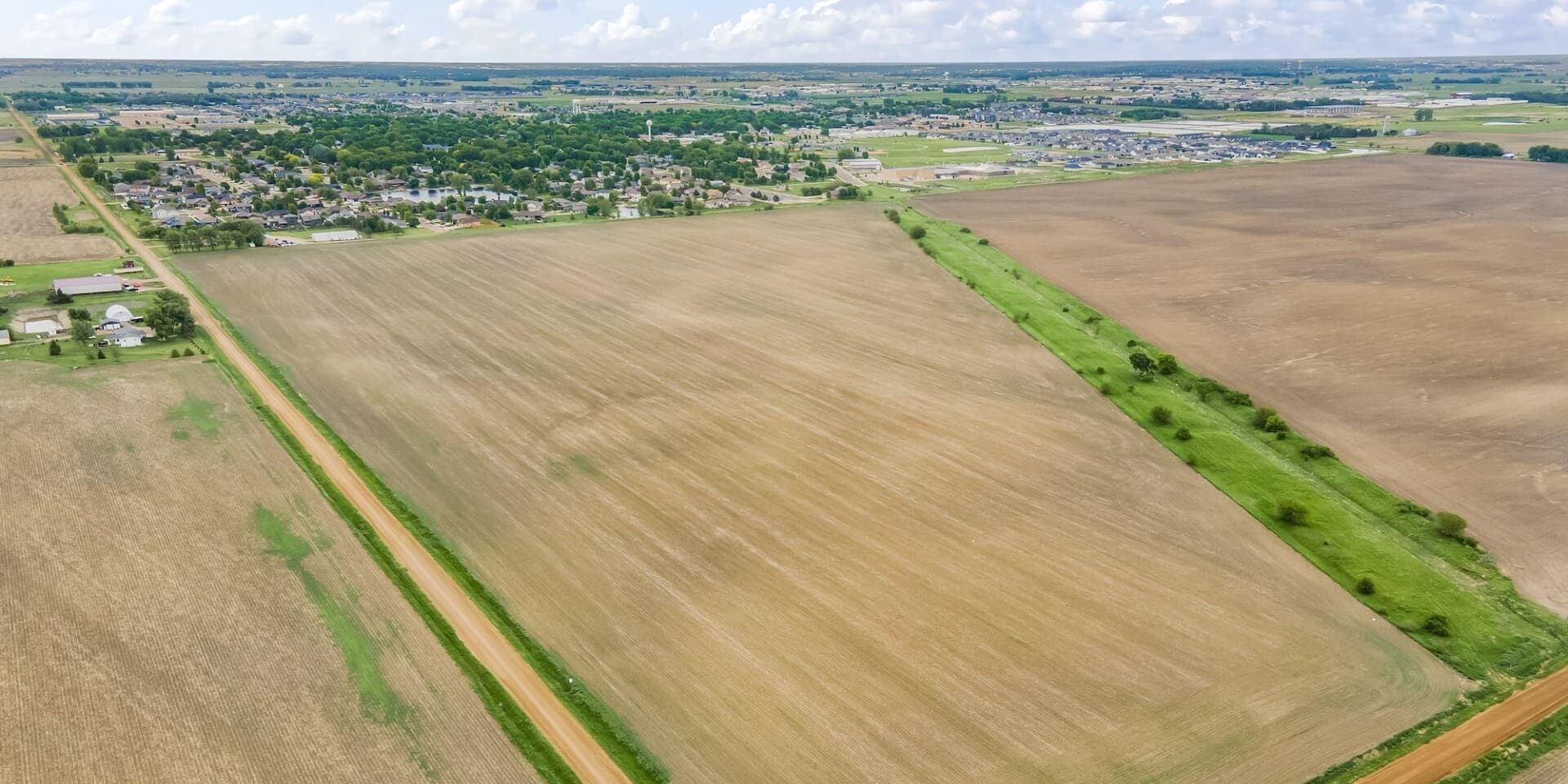
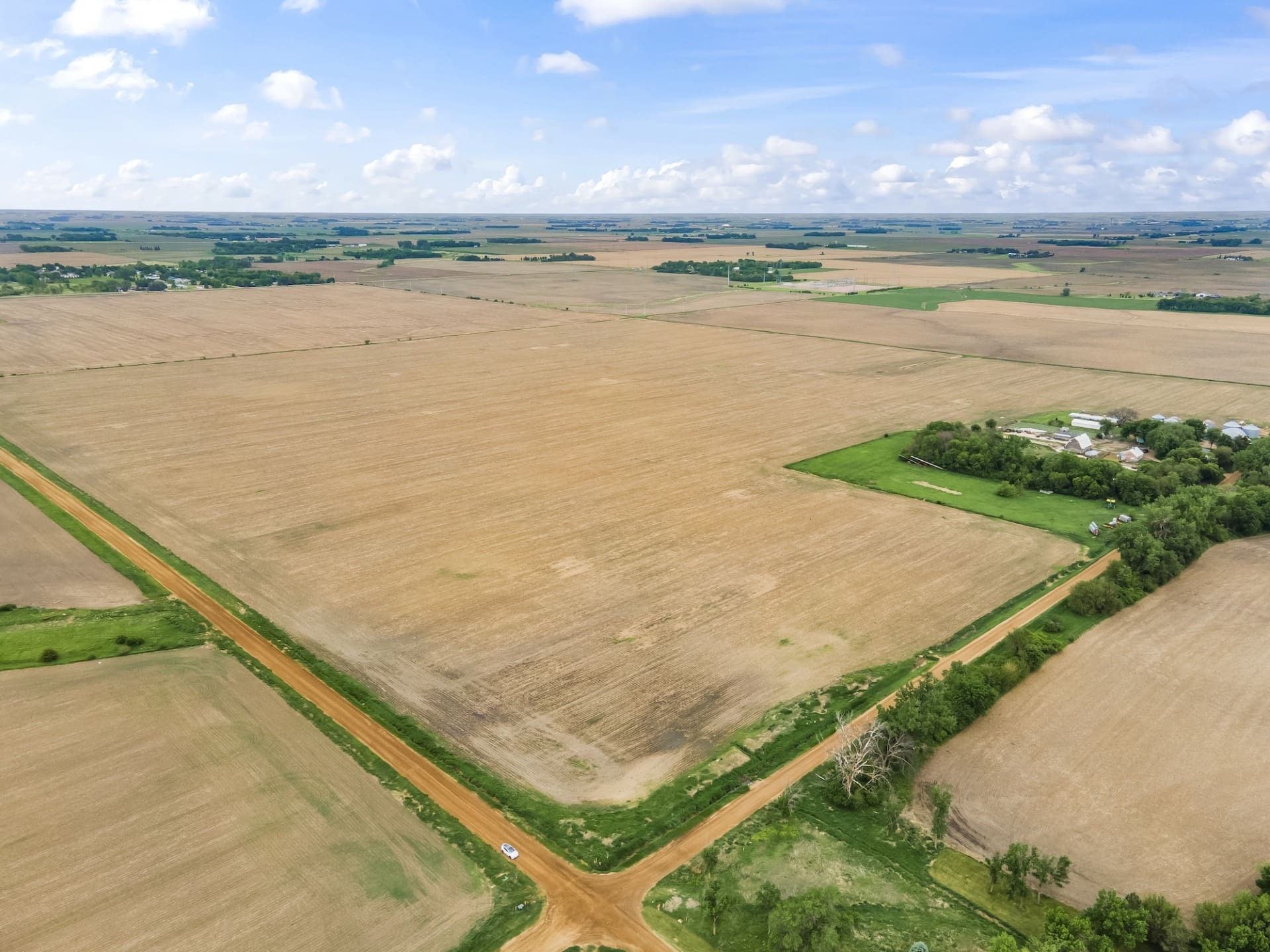
It’s part of a 380-acre parcel owned by the children of Henry and Cleo Mae Poppens, who farmed the area beginning in the 1940s.
“My parents worked the land with a lot of blood, sweat and tears,” said Mike Poppens, the youngest of the four siblings. “It was the core of our family farm operation, and that goes into why we’re trying to do this. For us, it would be rewarding to have an idea of how this land is going to be used in the future.”
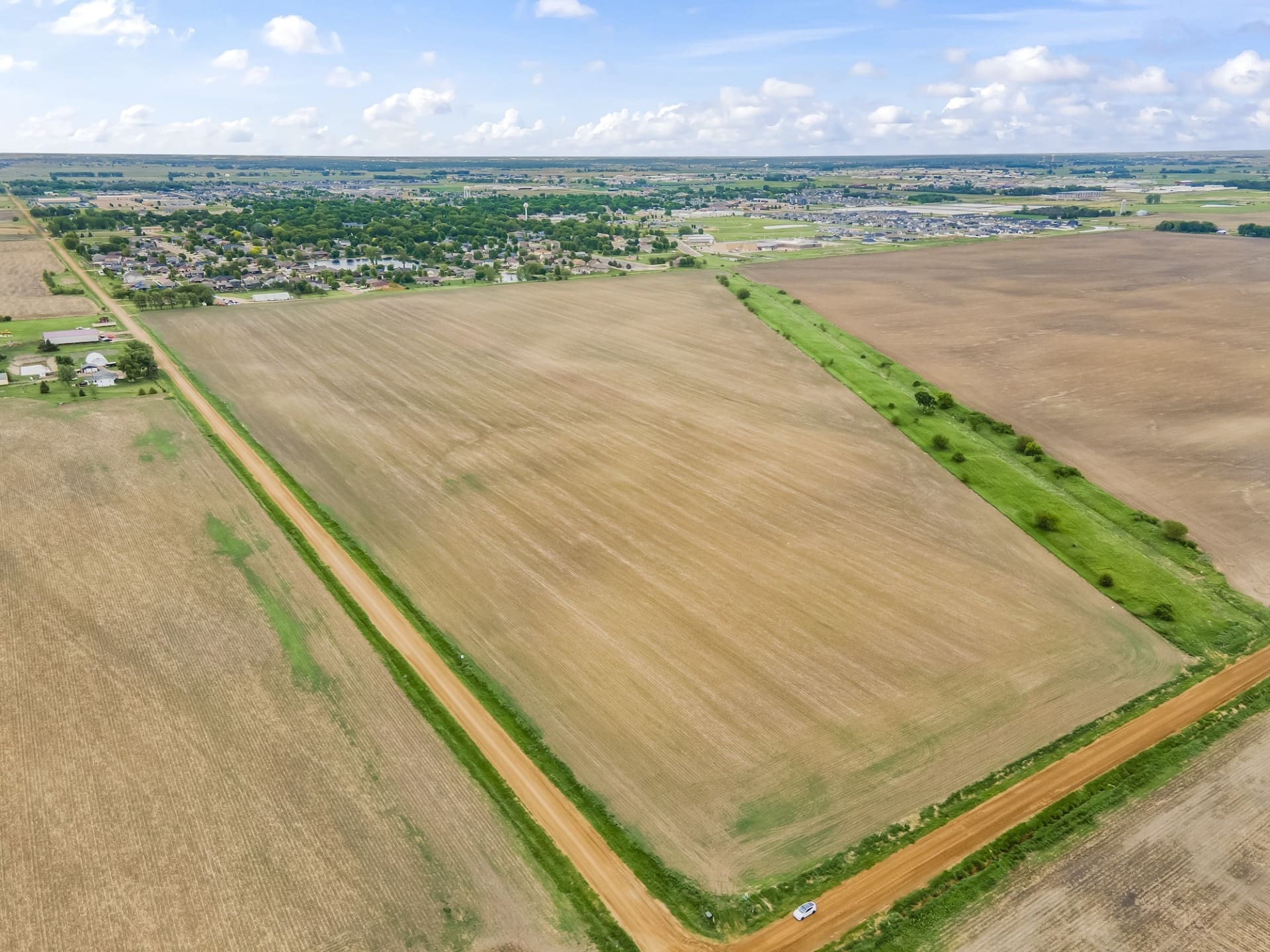
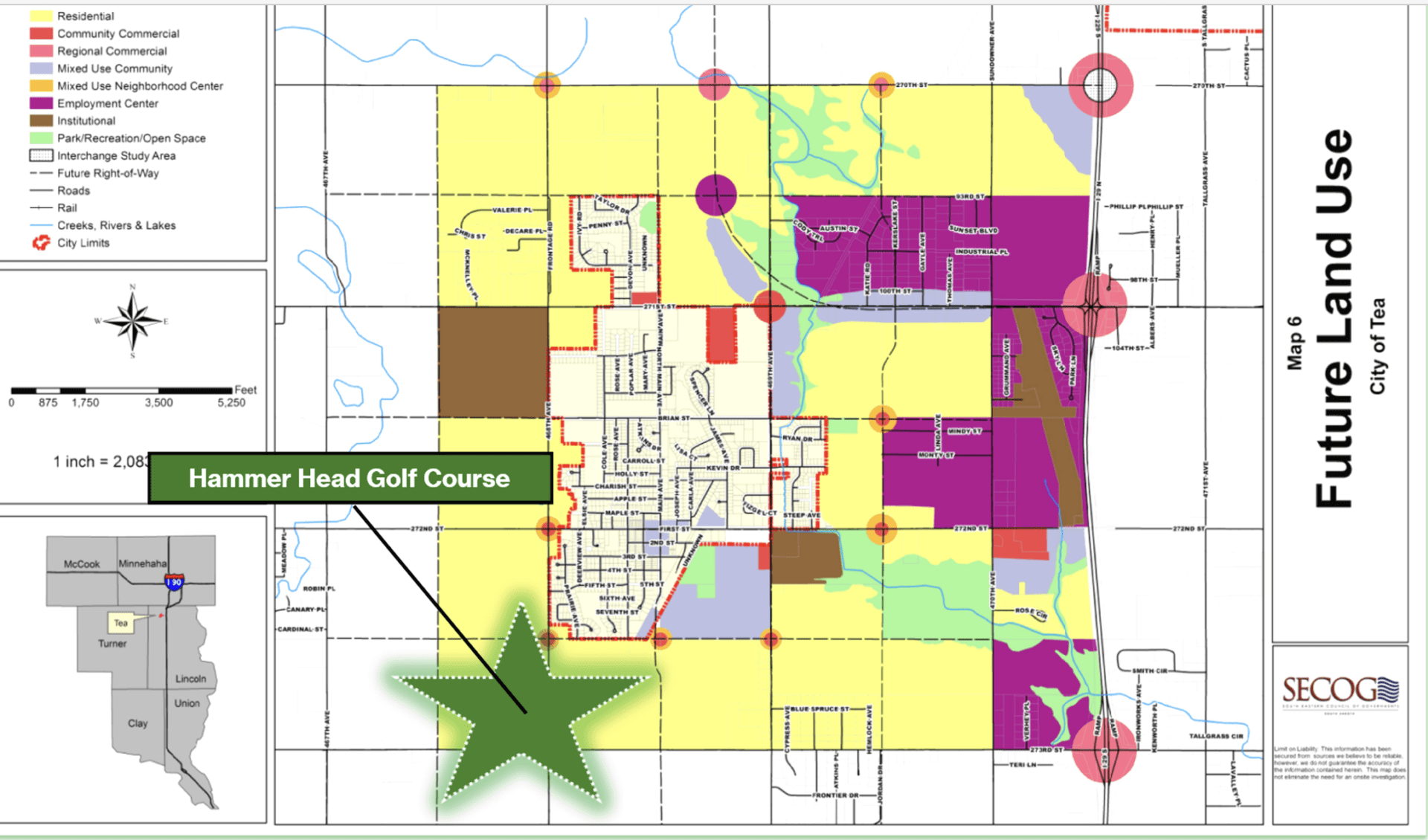
Hammer Head Golf Course would anchor the development just south of the current Tea city limits at 273rd Street and 468th Aveue not far from exit 73 on Interstate 29, which is scheduled to be replaced in 2030.
The name comes from Poppens’ father’s affinity for finding things in the field — a hammer head Native American tool being one of the most sought-after.
“We said, ‘Let’s take a look and find something that makes sense for a development project in Tea,” said Steve Van Buskirk, co-CEO of Van Buskirk Cos., who began talking with Poppens and his family last fall.
“It’s easy access in and out of town for people commuting to work, but when you actually get there on the top northeast corner of the property, it’s kitty-corner from an elementary school and straight south of new pickleball courts and a short walk up to the baseball fields and a huge park. And you walk a little further and you’re in the heart of historic downtown Tea, so it’s sitting on top of really great facilities.”

He envisions a mix of housing, including villa and single-family homes for about 320 total residences.
“We want to hit different price points, so we’re also talking about some rental townhouses,” Van Buskirk said. “What we really anticipate is we’ll provide a place where we’re going to get people who live in Tea and want to stay in Tea because that’s where their community is.”
He sees some residents selling single-family homes in favor of slab-on-grade villas, he said.
“And free up housing stock, so that will help the younger family moving to Tea or in Tea to take the next step forward.”
There is room for commercial development on the east end of the site.
“It will create more energy of the commercial corners … and closer to Heritage Boulevard,” Van Buskirk said.

“We have been having active conversations about an event center, the possibility of a bar and restaurant and the possibility of a fitness facility. When we get those things in place, we can see an office park developing around those services.”
The golf course was envisioned as the development group looked at what amenities Tea is lacking, he said. It’s being designed to include a practice facility and for the Tea Area School District to use as its home course.
Van Buskirk compared it to the area around Prairie Green Golf Course in Sioux Falls.
“If you take yourself back to 1995, it was pretty lonely out there at 69th and Minnesota and Cliff, and none of that commercial was there. But now look at how that has stimulated that whole area of town,” Van Buskirk said. “Some of our strongest household demographics are right around that golf course, and we think we can create the same sort of economic impact with Tea over the course of the decades.”
The development team recently presented the concept to the Tea City Council.
“We had a good meeting,” Van Buskirk said. “We wanted to get out there and put it out there in a very public way, and the council encouraged us to come out and have the conversations and talk about what we’re thinking … and they can decide if it’s something the community really wants to pursue.”
From the city’s perspective, “I don’t think it’s every day that cities are approached by a developer with this type of proposed development, so there’s definitely an excitement that comes with that,” city administrator Justin Weiland said.
“It’s tempered because we have to work through ways to find solutions to make infrastructure improvements happen.”
The area will require sewer improvements, water extensions and upgraded roads to service it.
At the same time, Tea already is anticipating a need for additional housing in the next five years, Weiland said.
“We really need to be planning for that next phase of residential housing, and we don’t have another land developer or landowner we’re speaking with right now with the exception of Mr. Poppens and Van Buskirk, so this is important if we want to continue to grow,” he said.
“We’re really looking at it as a full economic development opportunity and are in the process of vetting all the numbers and gathering all the potential little things because we don’t want to miss anything … and we need to make sure the numbers pencil out.”
The golf course is estimated to cost $15 million to $19 million, along with streets to serve it and a sewer lift station for the whole development.
“We’re exploring financing on that too,” Van Buskirk said.
The goal is to work through a plan with the city for development and financing “that we all can believe in … and then bring that back to the community and council,” Van Buskirk said.
The golfing community has responded with “a resounding yes” to the need for additional courses, he added.
“We hear stories about people driving to Beresford and Yankton for golf. The numbers are so incredibly strong. This is a Tea city course, but it will really serve the larger metro area.”
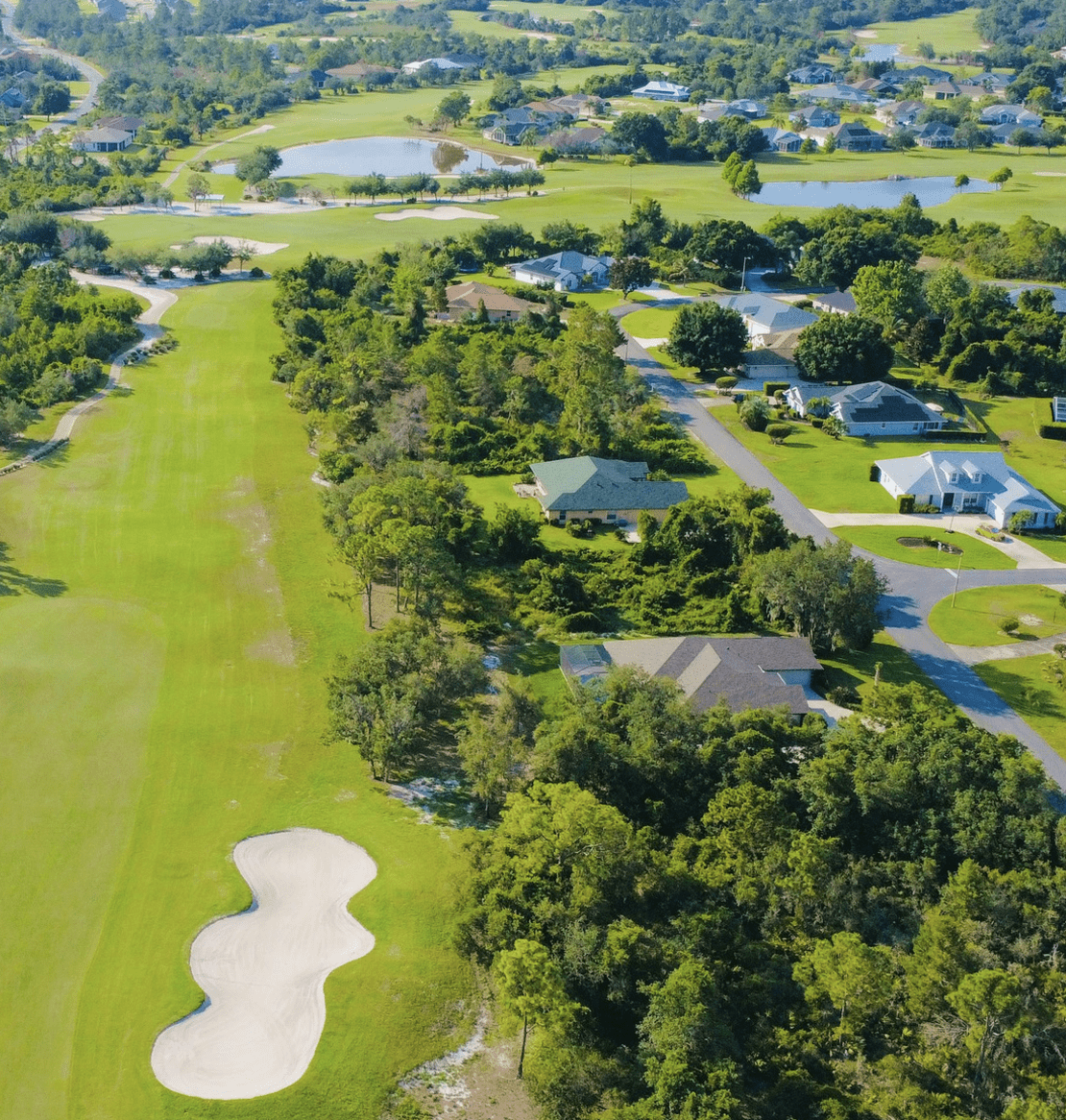
Van Buskirk also is seeing the demand for adjacent housing with its development along Mapleton Golf Club in northeast Sioux Falls.
“We’re seeing the power of a golf course and its ability to sell land and open up a new area of town,” Van Buskirk said. “We’re living it every day here at our office and feeling it, so that gives us a lot of encouragement to go down to Tea.”
The city also recognizes the demand, Weiland said.
Golf has been included in Tea’s comprehensive plan “for the better part of 20 years,” he said, including an updated plan adopted at the end of last year.
“I don’t think there’s any question would a golf course be supported. We talked about should we do a study, but we think demand is so high it’s not worth spending $50,000 on a study of could this be supported in our region.”
Poppens, whose daughters played high school and college golf, said the sport’s appeal is in its lifelong reach.
“I saw how well that has rounded their lives,” he said. “It’s a family activity … and Tea has done a great job on basketball, baseball, football; it’s just trying to balance out activities other people may not play and families may participate in.”
While there’s a cost to acquire the land and build the golf course, operationally golf courses in recent years have shown that they can generate revenue for cities. The city of Sioux Falls made more than $1 million on its three courses last year, the Hammer Head group said. Other communities still subsidize their courses.
Making the whole development work in Tea likely will require some sort of financing mechanism. The city is “looking at tax increment financing, maybe a sales tax revenue bond,” Weiland said.
“To fund some of the sewer improvements, we can establish a sewer district. We want to be upfront and honest and transparent abot the decision-making as we move forward — how we’re financing, all the communications we have — we’re being open and transparent about this with the public.”
The plan is helped by the fact that the Poppens family “is willing to be patient with this and see it through,” Van Buskirk added.
Poppens, a former Lincoln County commissioner, has watched decades of growth in the area, “and I was waiting for when the city was ready to take that step to the south,” he said.
“And not being a hinderance to the ability of the town to continue its proud balance. It’s got a little of this, a little of that, and it’s a wonderful community. It’s trying to create a more complete community, and our family hopes the community thinks this would be a good use for part of that land.”