Jodi’s Journal: Call centers, cost savings and the prison paradox
May 4, 2025
$1 billion doesn’t buy what it used to buy.
It’s kind of like how a $1 million house, while still quite nice, of course, isn’t the million-dollar home of 20 years ago or even a decade ago.
So when I heard a new South Dakota men’s prison — proposed for a rural site in Lincoln County on undeveloped land that would require infrastructure — would cost an estimated $825 million, I didn’t have quite the same sticker shock that our legislators did.
Still, it’s a big number — and it doesn’t include the cost to expand adjacent roads to accommodate the increased traffic.
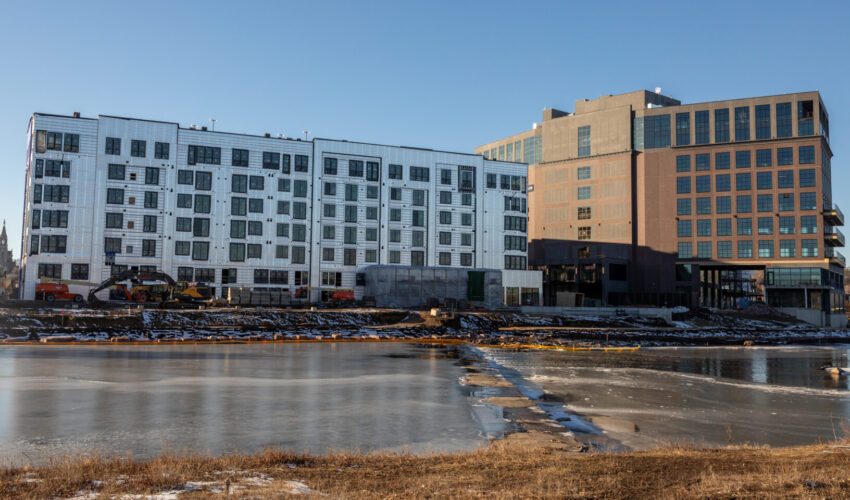
Combine the newly built Steel District and Cherapa Place projects in downtown Sioux Falls — with multiple multistory buildings and two parking ramps — and you’re still a couple hundred million less than that, though clearly there’s a difference between building luxury lofts and maximum-security pods.
However, there’s no question that moving to an area that still needs to be developed with roads, utilities and all the necessary buildings is more expensive than using an existing site.
I’ll admit, I didn’t have “Former Citibank campus becomes new South Dakota men’s prison” on my 2025 bingo card. But the more I considered it, the more it seemed worth others considering.
Is it ideal to retrofit old office space into new administrative space? Maybe not. But it’s also cost-effective enough that a story we recently reported found many former call centers filling faster than they have in years, including with nonprofits realizing they will never be able to gain that much square footage waiting to build new.
If this pace of absorption keeps up, we actually could begin to see somewhat of an office space shortage, contrary to many metro areas nationwide that still have not recovered from the pandemic-driven flight to remote work.
If there’s anything de rigueur in government today, it’s controlling spending, right?
So why not explore what it might look like to convert a campus within the city limits to a prison? It’s interesting to consider. The proximity to other correctional and government facilities is there. So is the workforce. It’s not in a residential area. And my guess is there might be opportunities to acquire adjacent property with a little patience — especially as it’s not needed today. Surface parking lots could become home to new buildings, with underground or raised parking in the future too.
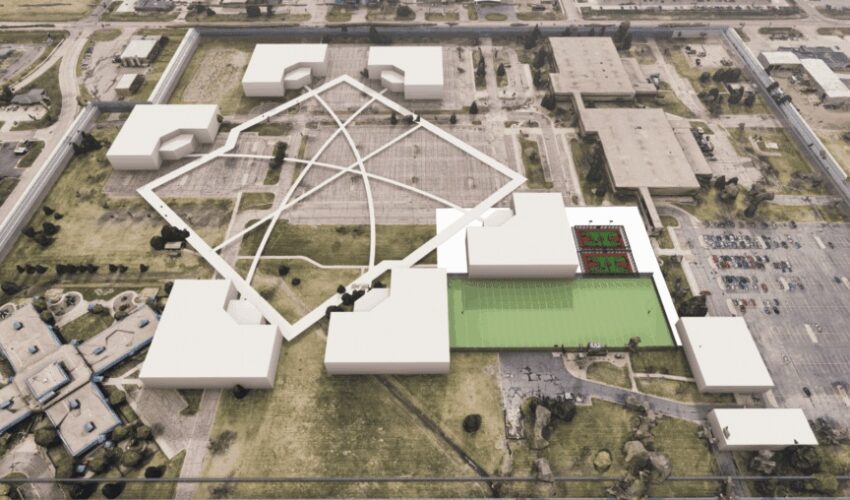
The buildings on the site are envisioned as office space for state government, there’s a former child care center that has some interesting possibilities even for employees, and there’s enough land for numerous inmate “pods” that the state has designed.
Here’s the sketch of a site plan submitted for consideration by the Project Prison Reset task force — one of 14 locations now potentially in the mix.

Information included with the proposal noted that its estimated project costs would be 40 percent less than the original proposed location, “with an enhanced focus on rehabilitation and education, resulting in lower recidivism rates.”
And there inherently lies the prison paradox. In redefining an approach to building one, we might be able to keep people out of it.
The most eye-opening thing to me in this process isn’t that the state’s proposed facility could cost $825 million. It’s that the state is proposing to pay that in cash.
This is a once-in-a-generation project that seems like a ready-made case for bonding, especially given that rates are not historically high and there should be opportunity to refinance if needed.
Regardless, if there’s capacity to spend more than $800 million for corrections, why not take a bigger, broader view with it? Why not see what can be saved by either retrofitting a site or exploring a lower-cost alternative and then use the balance to make the investments that could lead people away from incarceration?
With money saved, the state could invest in residential facilities with wraparound case management near where people have support systems, instead of funneling them to Sioux Falls and Rapid City. Imagine these places in communities across South Dakota near where people who struggle with addiction and recidivism might have family or friends.
Money also could be invested in both housing and workplaces to support helping released inmates integrate back into society — and again be done statewide where people have greater support systems.
I admittedly am joining this conversation late in the game, and I’m sure there could be plenty of factors already studied to recommend the state’s current approach. But if the idea is a reset, this seems like a time to think differently — not just location, but financing and scope — to make a more effective investment.
Building a prison is about the most depressing public project I can conceive. It’s clearly necessary but only because individuals and often we as a society have failed at other points along the way. Maybe by wrapping a little more vision around it, we can salvage some wins.
Additional sites proposed for prison include some in Sioux Falls area