DSU associate professor recognized by national peers
June 6, 2024
This paid piece is sponsored by Dakota State University.
Kyle Cronin was still in middle school, helping his folks with their dairy operation, when he first became interested in computers.
“I got interested in how the technology was working on the farm,” he said.
In high school, he pursued that interest by taking his first computer classes. Now, after completing undergraduate and graduate programs in information systems at Dakota State University and a doctorate from Capitol College, now Capitol Technical University in Laurel, Maryland, he is an associate professor in The Beacom College of Computer and Cyber Sciences.
Cronin also serves as the coordinator for the university’s Center of Academic Excellence – Cybersecurity (CAE-C) designation. In that capacity, he spends a lot of time on airplanes. Last year alone, he took 77 flights out of 16 airports, logging 45,976 miles.
He does this because he learned something else on the farm – that you have to work together to succeed. He knows that DSU can’t fill every cybersecurity opening in the nation with its graduates and works to help other universities that are struggling with their programs.
“It’s fun to be the person who can say, ‘We can help you with that,’” Cronin said.
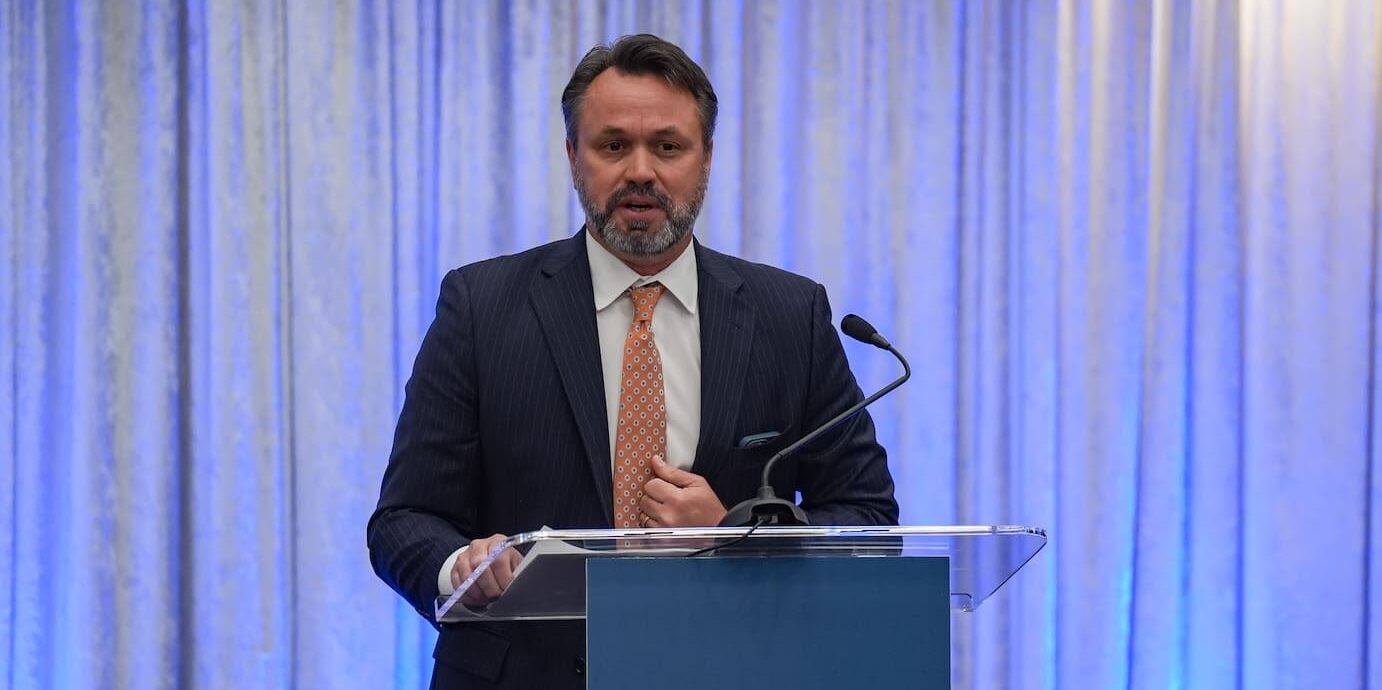
Recently, he was recognized for his work in St. Louis at the CAE in Cybersecurity Community Symposium. Standing on stage, looking out at a sold-out audience of his peers, Cronin accepted the 2024 Outstanding NCAE-C Community of Practice in Cyber Operations (CoP-CO) Service Award, in recognition of his outstanding cybersecurity contribution to the community and the nation.

Cronin accepted the award gratefully, pleased to have his contributions acknowledged by his peers. But when he talks about his work, he talks in terms of what the university does and what is possible because Dakota State has built a strong cybersecurity program.
“Over the years, the university here has had so many major projects that we’ve been involved in,” he said. “There are so many nationwide initiatives we work with.”
He illustrated this by talking about the GenCyber program, a summer camp for high school students which is funded by the National Security Agency and the National Science Foundation. DSU developed the prototype for the program, offering the first summer camps before a nationwide program existed.
“One of the initiatives we offer is faculty development,” he said, speaking of another program. “How can we take some of our best and brightest modules and get other schools up to speed as well?”
Cronin said DSU’s “awesome enrollment” makes this possible. Because the university has a large cybersecurity program – between 1,300 and 1,400 students annually, with more than half taking courses on campus – faculty have the opportunity to develop teaching materials on difficult topics that require a technical background.
“We have a lot of kids to test it with,” Cronin said. With student feedback, faculty is able to fine-tune the materials which DSU can then offer to others who are able to adapt them for their classrooms.
Although articulate and passionate when speaking about DSU, Cronin does not draw attention to himself or his contributions. When finally asked why he, personally, received the award, his answer was simple.
“I end up being the face of the program,” Cronin said. Because he’s actively involved in the university’s initiatives, he has “a lot of opportunity to know the community and faces across the nation.”